Agency > Intelligence
Keynote Slides
Copyright © 2026 | humanskills.ai LLC. | All Rights Reserved
Agency > Intelligence: We Are All Directors of Abundant Intelligence Now
Intelligence is no longer the scarce resource. AI has made it abundant, accessible, and increasingly cheap. What's scarce now is the human capacity to direct it well. The professional advantage going forward isn't knowing more or working faster. It's knowing what to point intelligence at, when to trust it, and when to override it. That's agency. And developing it is a skill, not a personality trait.
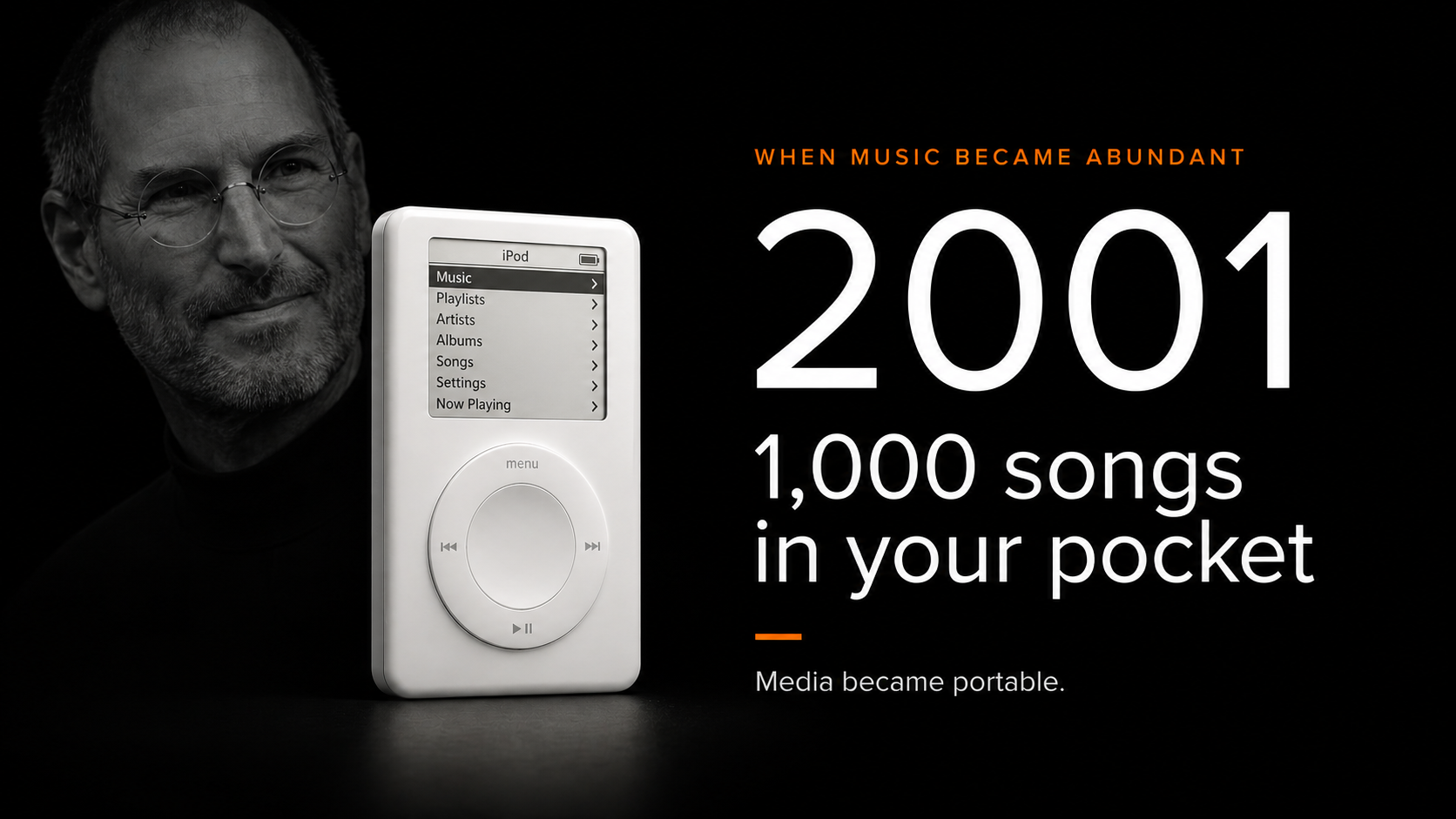
2001: 1,000 Songs in Your Pocket
25 years ago, Apple put your entire music library on a device that fit in your hand. At the time, that felt like the biggest thing abundance could mean.
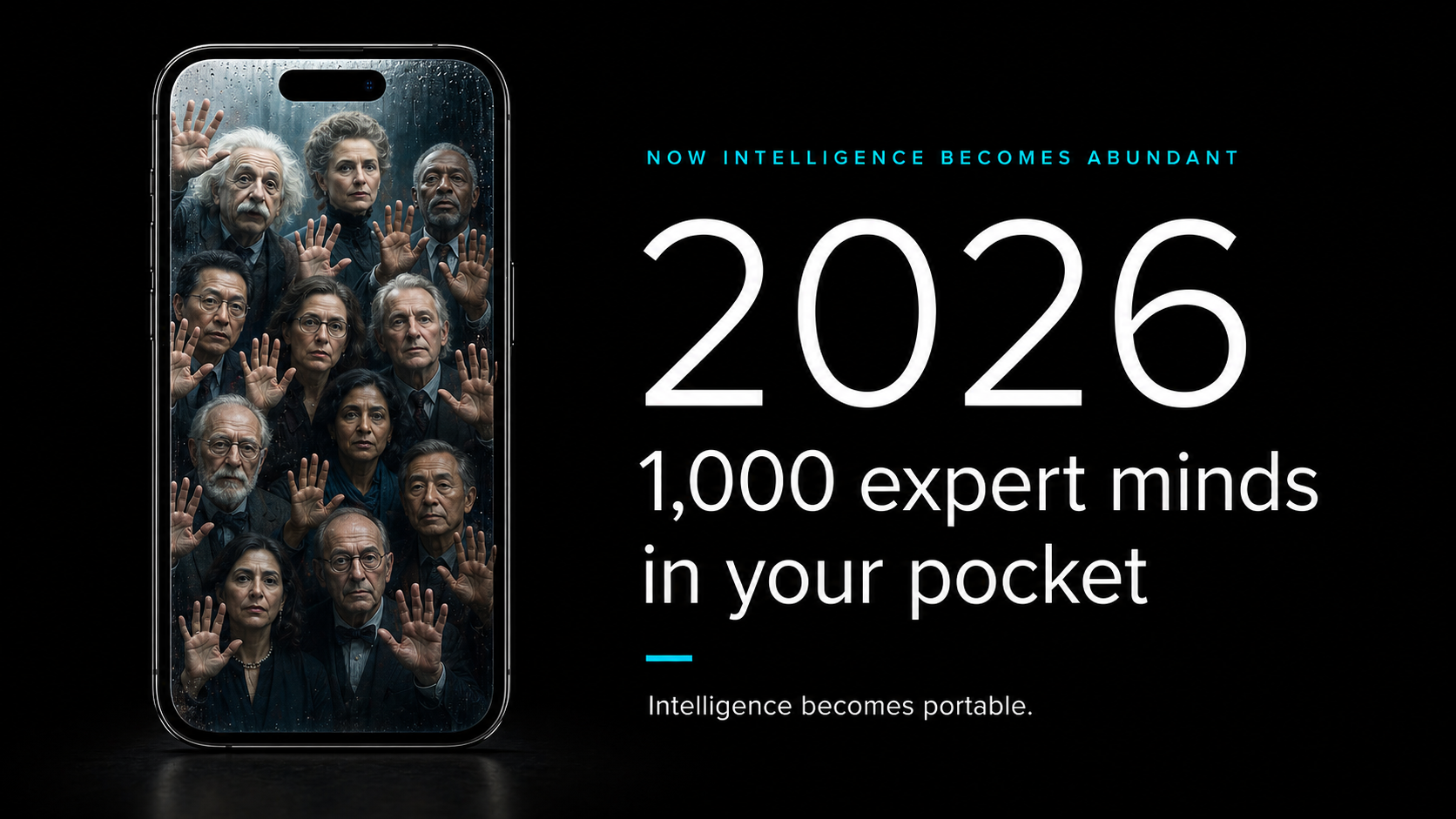
2026: 1,000 Expert Minds in Your Pocket
Now the AI companies are promising taht the same device gives you access to PhD-level reasoning across virtually every discipline, on demand, for a monthly subscription. The question the music industry had to answer after the iPod applies to every knowledge profession now: once access to intelligence is no longer the bottleneck, what actually becomes valuable?
Finding Signal in the Silicon Valley Noise: Deciphering the Future of AI Amidst Hype, Headlines, and Hyperbole
Every major tech CEO is making bold claims about where AI is heading, and they all have enormous financial incentives to shape that narrative. The skill isn't ignoring them. It's learning to read the moves behind the messaging, separate infrastructure bets from marketing theater, and build your own informed perspective on what actually matters for your work and your institution.
Situational Awareness: Plan for Tomorrow's AI
AI capabilities are changing faster than most institutional planning cycles can absorb. This section looks at what's coming next so you can build strategy that holds up even as the technology underneath it keeps moving.
When Will Top Quartile Human Performance Be Achieved with AI?
In 2017, experts placed most AI milestones decades out. By 2023, those same timelines had collapsed by 20 to 40 years. Natural language generation, pattern recognition, sensory perception... capabilities that were supposed to be a generation away are here now. The pattern matters more than any single date on the chart: if your strategy depends on AI staying roughly where it is, the research says you're already behind.
When Will Top Quartile Human Performance Be Achieved with AI?
In 2017, experts placed most AI milestones decades out. By 2023, those same timelines had collapsed by 20 to 40 years. Natural language generation, pattern recognition, sensory perception... capabilities that were supposed to be a generation away are here now. The pattern matters more than any single date on the chart: if your strategy depends on AI staying roughly where it is, the research says you're already behind.
What Does It Mean When AI Scores >140 on a Mensa IQ Test?
Leading AI models hit average human cognitive performance in 2024. A year later, they crossed into the top 2% of the population on standardized measures, and the trajectory hasn't flattened. IQ tests don't capture everything that matters, but they do capture something important: raw cognitive horsepower is becoming commodity infrastructure. The professional value proposition has to come from a different place now.
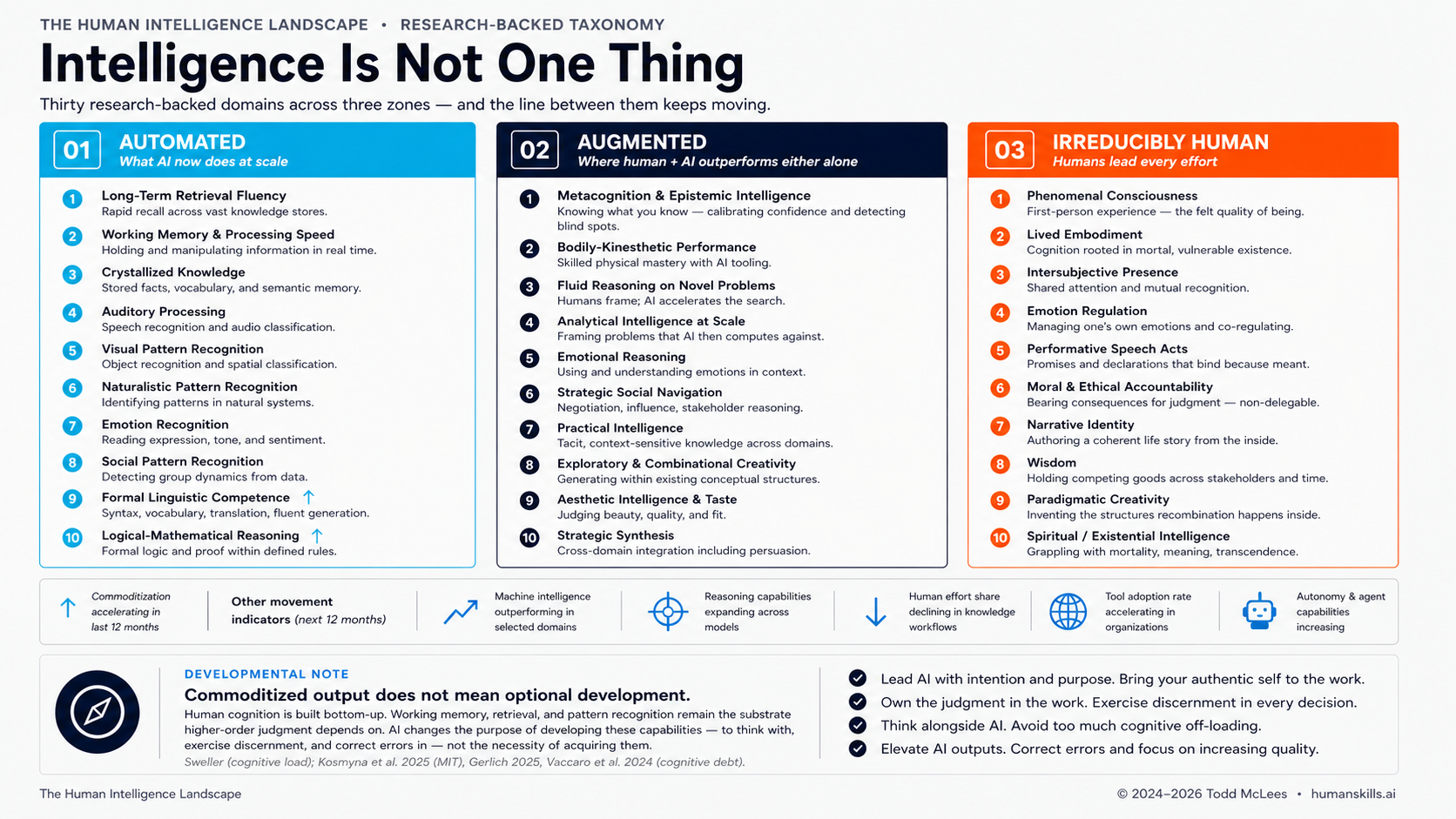
The Human Intelligence Landscape
Not all human capabilities face the same AI pressure. This framework maps the terrain: embodied intelligence, lived intuition, and ethical responsibility remain distinctly human moats. Creativity, wisdom, and contextual reasoning sit on an erosion watchlist—still human advantages, but narrowing. Learning efficiency and pattern recall? AI has already arrived. Understanding where your work falls in this landscape helps with planning.
Seven Capability Revolutions Reshaping Intelligence
AI isn't one thing—it's a cascade of expanding capabilities, each unlocking new forms of human partnership. From language models (2022) through reasoning, multimodal perception, and agentic execution, to emerging world models, embodied AI, and spatial intelligence. Each layer builds on the last. Understanding this evolution is essential for knowing where human agency fits in.
AIME 2025 Benchmark: Top 8 Models
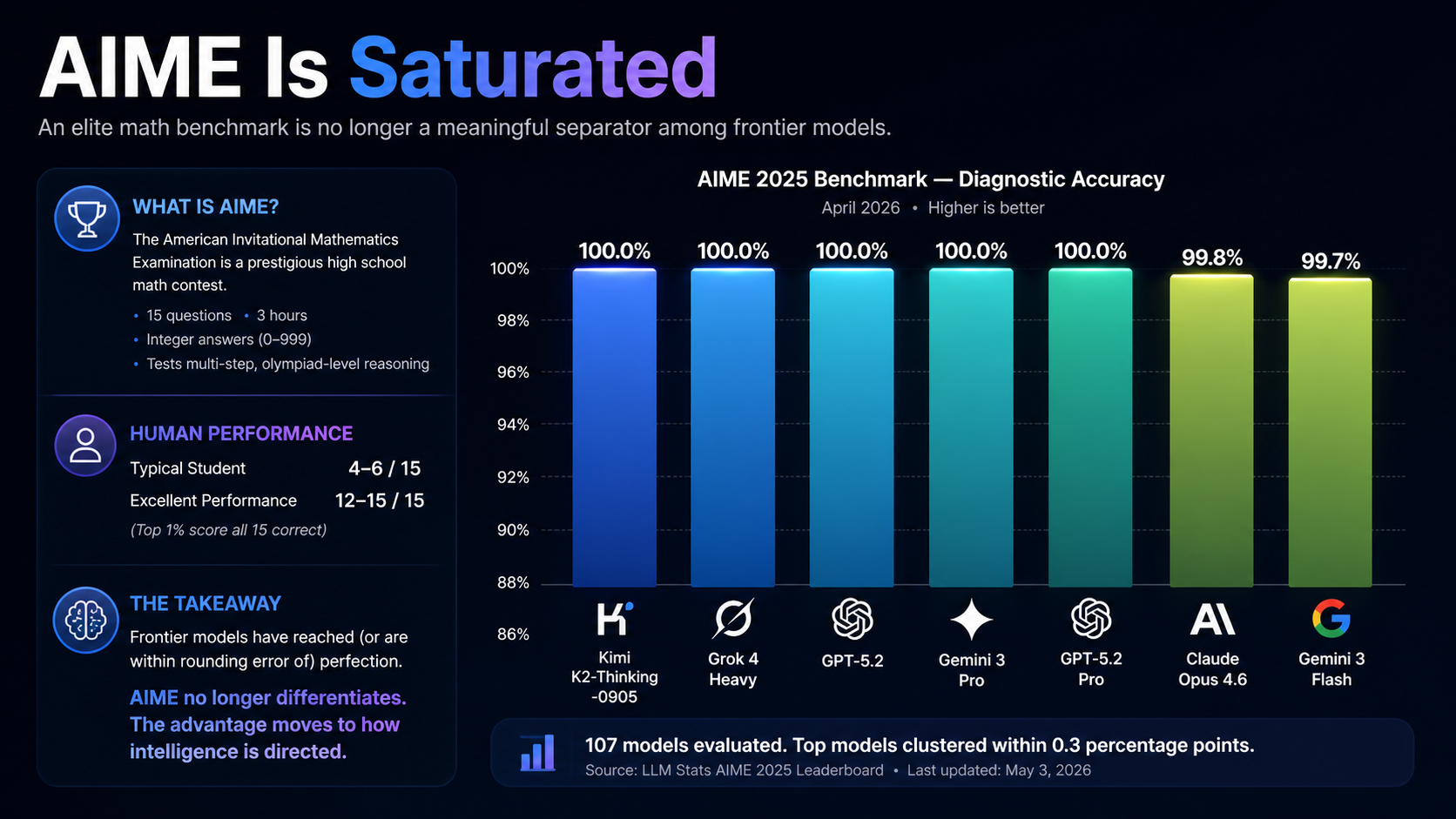
The American Invitational Mathematics Examination is designed to challenge the top high school math students in the country. As of December 2025, the leading AI model scores 100%—perfect accuracy. Eight different models now exceed 91%. A benchmark designed to challenge elite human talent no longer differentiates between humans and AI.
Software Engineering: SWE Bench Verified
On the industry-standard benchmark for real-world coding tasks, the leading AI model now outperforms the top 2% of human software engineers. Six different models have crossed the 74% threshold, with Claude Opus 4.5 exceeding 80%.
GPQA Diamond Benchmark: PhD-Level Domain Expertise
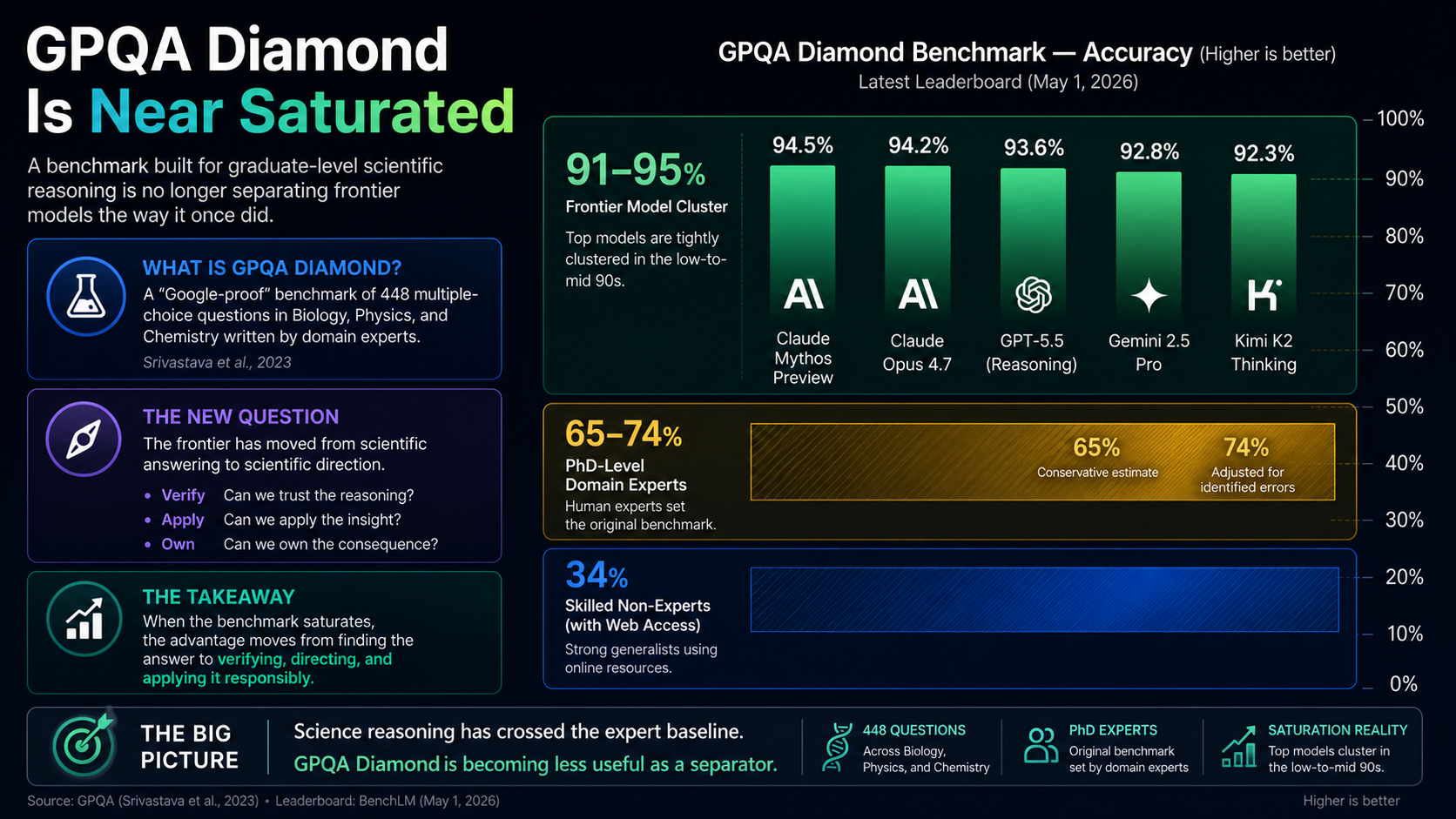
The Graduate-Level Google-Proof Q&A Diamond benchmark tests questions so specialized that even domain experts with internet access score only 65–74%. Ten AI models now exceed that range, with top performers pushing past 90%. The "Google-proof" knowledge barrier (questions too complex to simply search) no longer stops machines.
Human x AI Innovation Flywheel
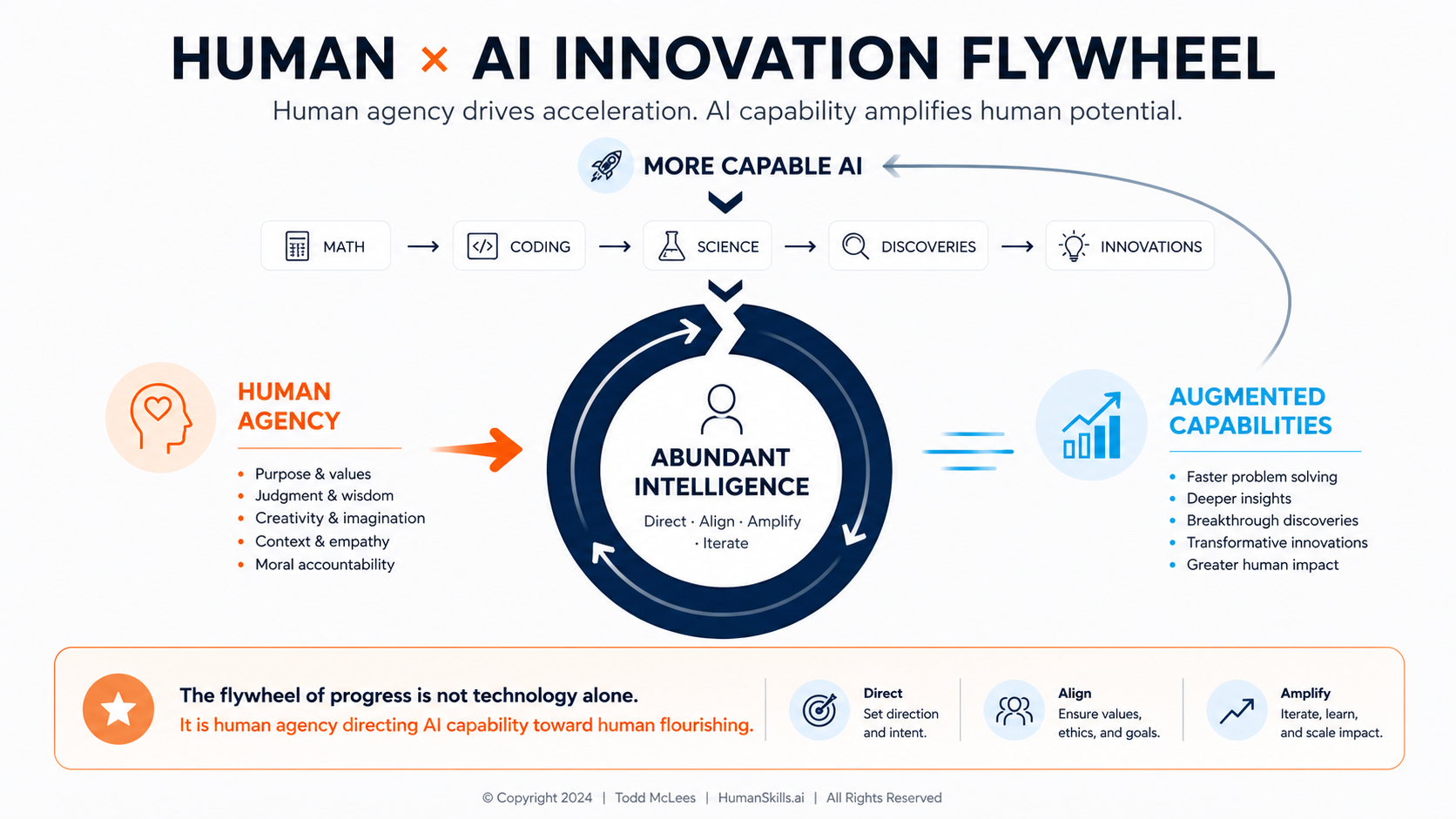
This isn't a one-directional story where AI replaces human contribution. Human agency directs intelligence toward problems worth solving. AI capability amplifies what humans can reach. More capable AI feeds back into new discoveries, which produce new innovations, which fund more capable AI. The flywheel only spins when both sides are engaged. Agency is what keeps humans in the loop as a force multiplier, not a spectator.
Six Projected Breakthroughs for 2026: What AI's Architects Say Will Come Next
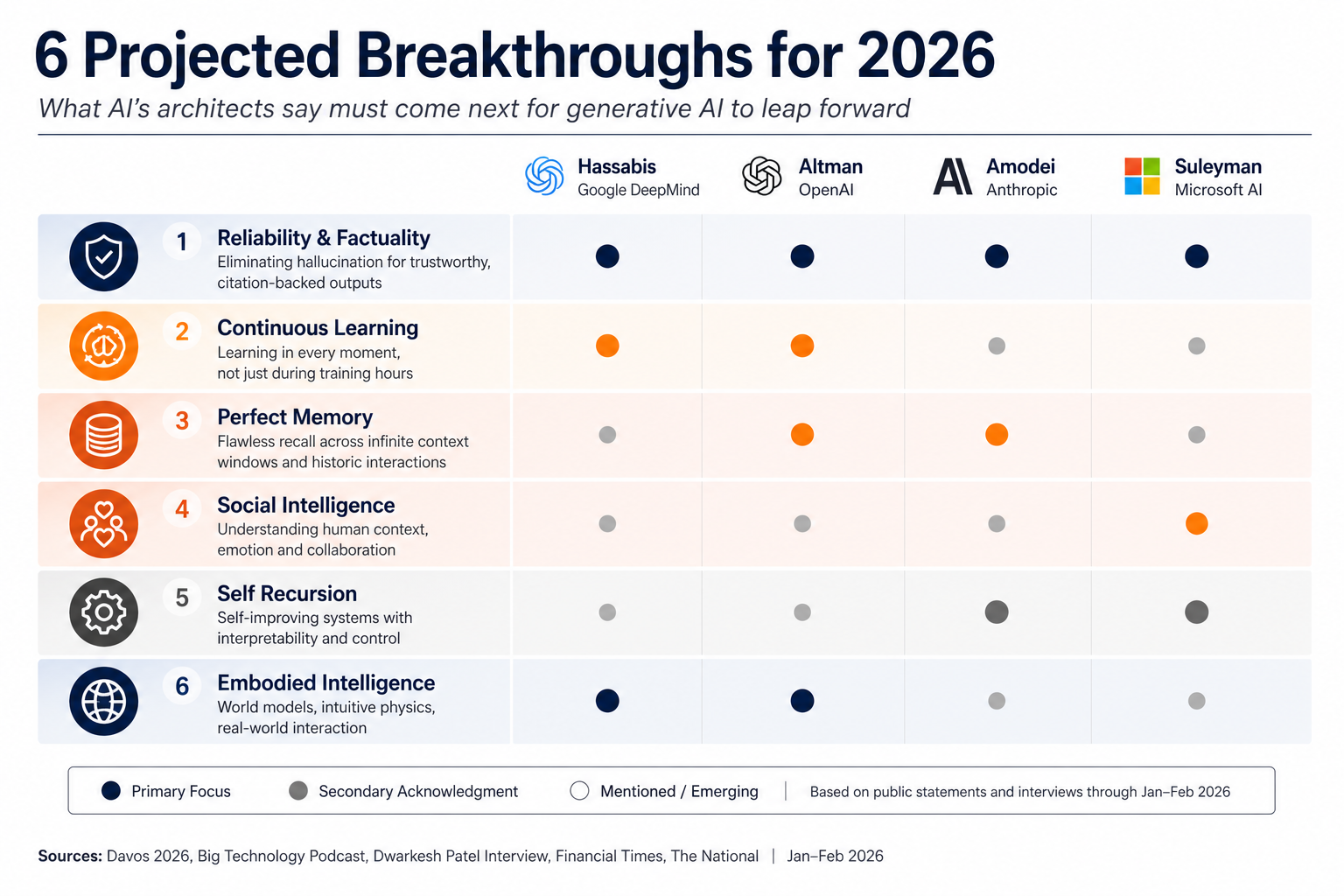
The leaders building these systems largely agree on where the gaps are: reliability, continuous learning, perfect memory, social intelligence, embodied intelligence, and the bonus that keeps the safety community up at night, self-recursion. Where they disagree is on priority and sequence. Reading across their public statements from early 2026, the convergence tells you what's coming. The divergence tells you who's betting on what, and why.
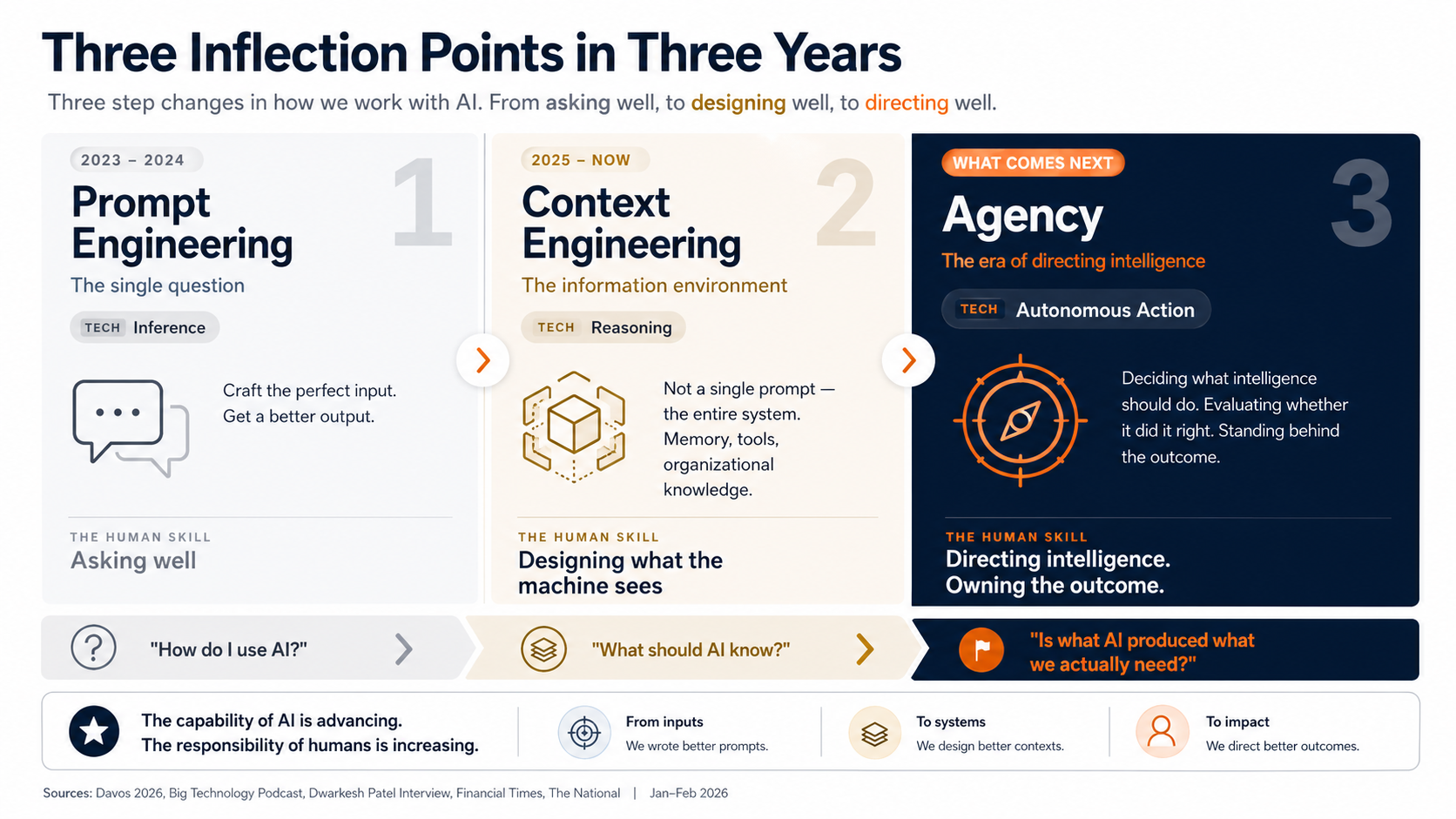
Three Inflection Points in Three Years: From Asking Well to Designing Well to Directing Well
The work has shifted twice in three years. 2023–2024 was prompt engineering, where a well-crafted question produced a better answer. 2025 to now is context engineering, where the prompt matters less than the system around it: memory, tools, organizational knowledge. What comes next is agency, the era of directing intelligence and owning the outcome. The technology has moved from inference to reasoning to autonomous action, and the human skill has moved with it. The capability of AI keeps advancing. The responsibility of the humans using it keeps increasing.
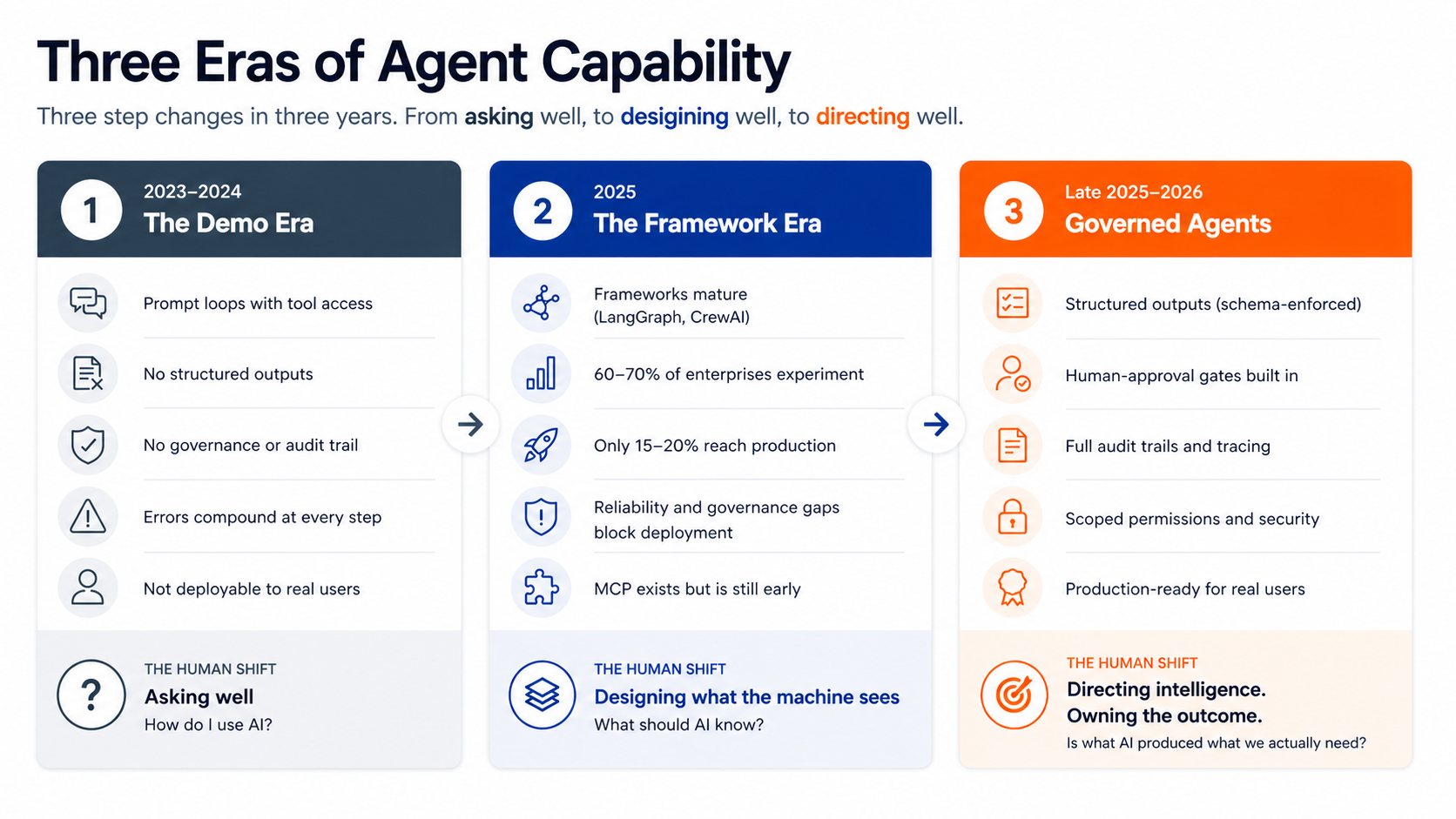
Three Eras of Agent Capability: From Demos to Frameworks to Governed Agents
Agents have moved through three distinct stages in three years, and the gap between each one is bigger than it looks. The Demo Era of 2023–2024 was prompt loops with tool access, no structured outputs, no governance, errors compounding at every step, nothing you could put in front of a real user. The Framework Era of 2025 brought LangGraph, CrewAI, and serious enterprise interest, with 60–70 percent of enterprises experimenting but only 15–20 percent reaching production. Reliability and governance gaps blocked deployment. Late 2025 into 2026 is the era of governed agents: schema-enforced outputs, human-approval gates, full audit trails, scoped permissions, production-ready for real users. The technical story is one of maturity. The human story underneath it is the same arc as the previous slide. Asking well, designing well, directing well. The agents got governable. The question is whether the people working with them learned to direct what now actually deploys.
What Changed in the Last Six Months: Eight Capabilities That Make Governed Agentic Learning Possible
The shift to governed agents was not one breakthrough. It was eight, and they all landed inside a six-month window. Permission before action means agents must ask before doing anything consequential. Scoped permissions limit them to what is explicitly authorized. Structured responses replace freeform text with schema-enforced outputs. Capability discovery lets agents find tools through standardized descriptions. Full audit trails make every action traceable. Session continuity holds context across modules and days. Background execution allows long-running tasks with async check-back. Domain extensions provide standard patterns for education, healthcare, finance, and more. Each one is a prerequisite for Virgil, and none of them existed in production form before late 2025. Together they turn AI from a tool into governed learning infrastructure. The capability stack underneath agentic learning was rebuilt in a single half-year.
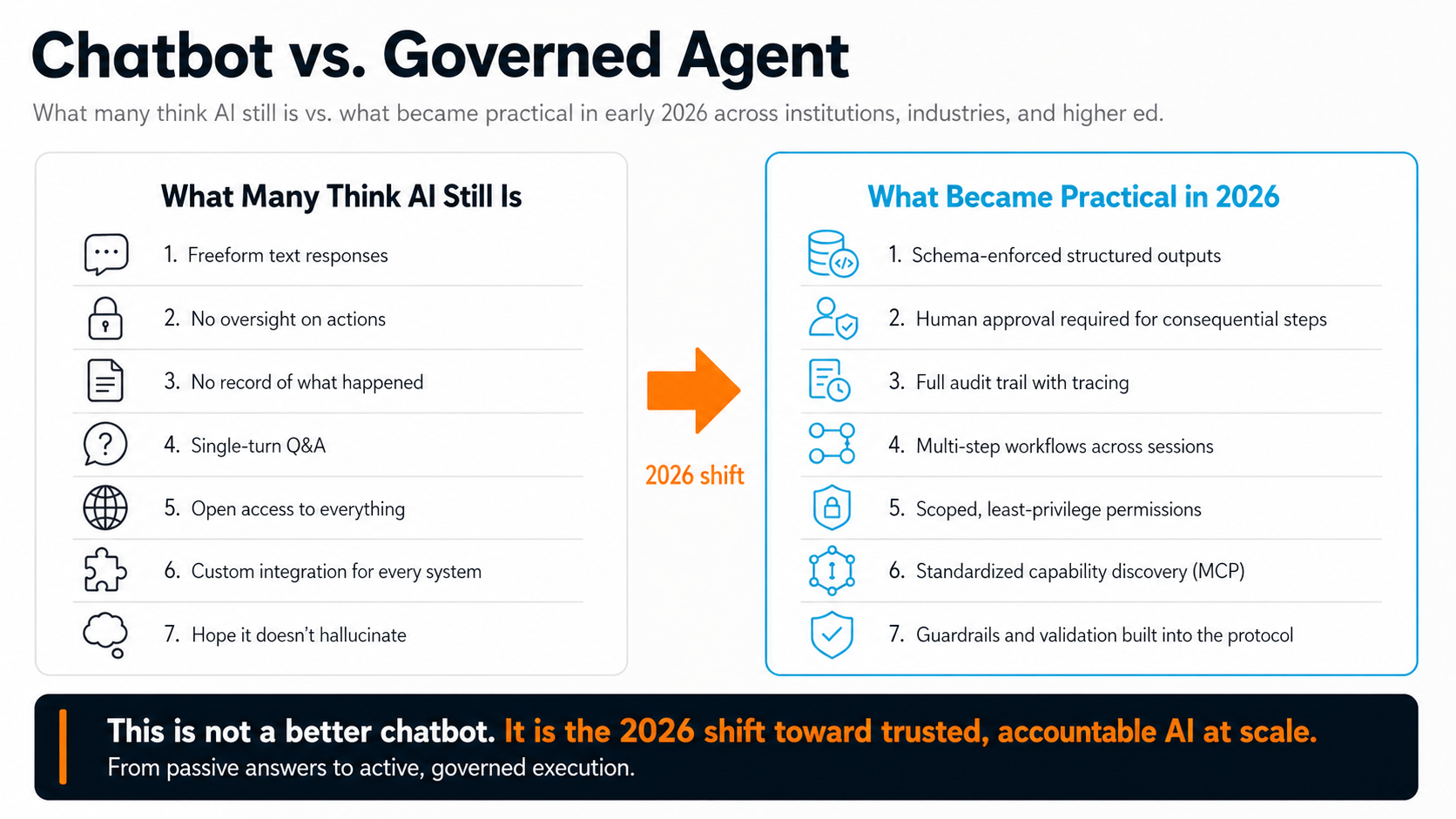
Chatbot vs. Governed Agent:
What Many Think AI Still Is vs. What Became Practical in 2026Most people are still working with a mental model that ended a year ago. They picture AI as freeform text responses, no oversight on actions, no record of what happened, single-turn Q&A, open access to everything, custom integration for every system, and the quiet hope that it does not hallucinate. What became practical across institutions and industries in early 2026 is a different category of system: schema-enforced structured outputs, human approval required for consequential steps, full audit trail with tracing, multi-step workflows across sessions, scoped least-privilege permissions, standardized capability discovery through MCP, and guardrails built into the protocol itself. This is not a better chatbot. It is the shift from passive answers to active, governed execution. The gap between the two columns is where most organizations are still operating, and it is also where the next eighteen months of competitive separation will happen.
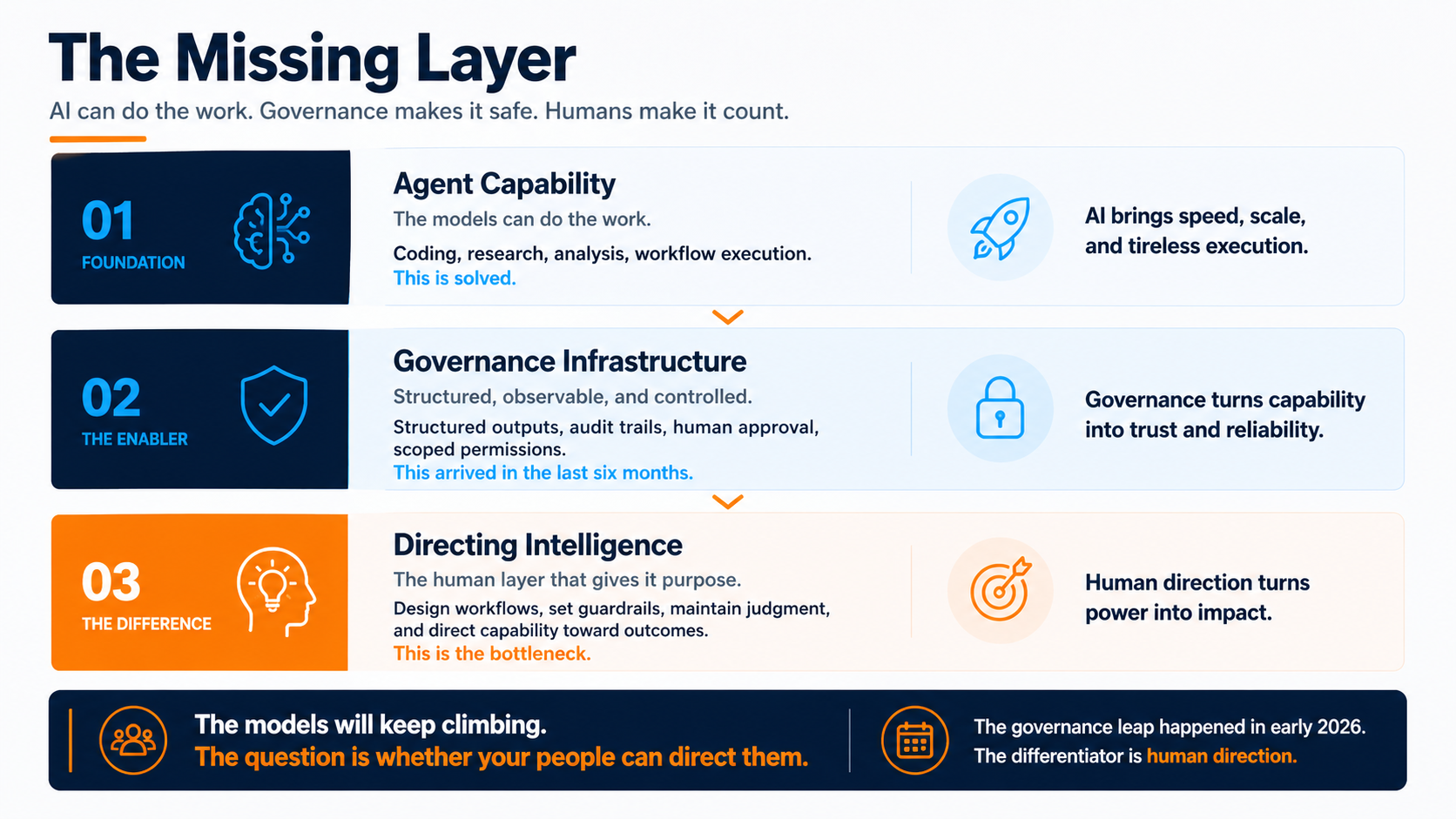
The Missing Layer:
AI Can Do the Work. Governance Makes It Safe. Humans Make It Count.Three layers, and only one of them is still in question. Agent capability is the foundation, and it is solved. Coding, research, analysis, workflow execution, all running at speed and scale. Governance infrastructure is the enabler, and it arrived in the last six months. Structured outputs, audit trails, human approval, scoped permissions. The third layer is directing intelligence, the human work of designing workflows, setting guardrails, maintaining judgment, and pointing capability at outcomes that matter. That is the bottleneck. The models will keep climbing. The governance leap already happened. The differentiator now is whether the people inside an organization can actually direct what the system can do.
The 2028 Global Intelligence Crisis / The 2028 Global Intelligence Boom
Same forces, two very different headlines. Whether the explosion of AI capability reads as crisis or boom depends entirely on how prepared institutions and individuals are when it arrives. The framing is the point: the underlying event is the same either way.
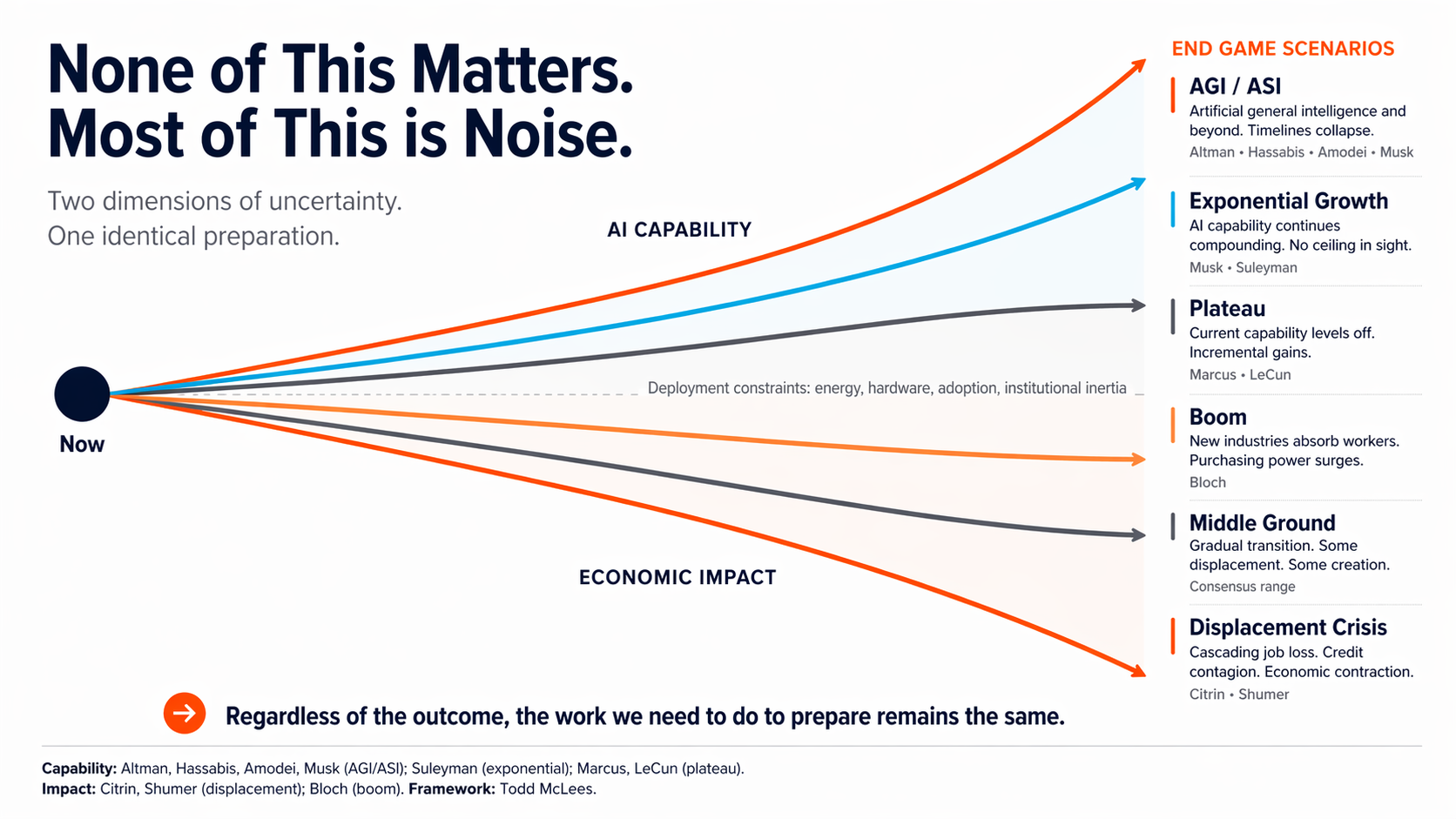
None of This Matters. Most of This is Noise.
Experts disagree on whether AI capability plateaus or goes exponential. They disagree on whether the economic impact is a boom or a displacement crisis. But here's what makes the debate academic for practitioners: across every scenario on this chart, the preparation is identical. Build human agency. Learn to direct intelligence well. That work pays off whether we get the optimistic outcome or the difficult one.
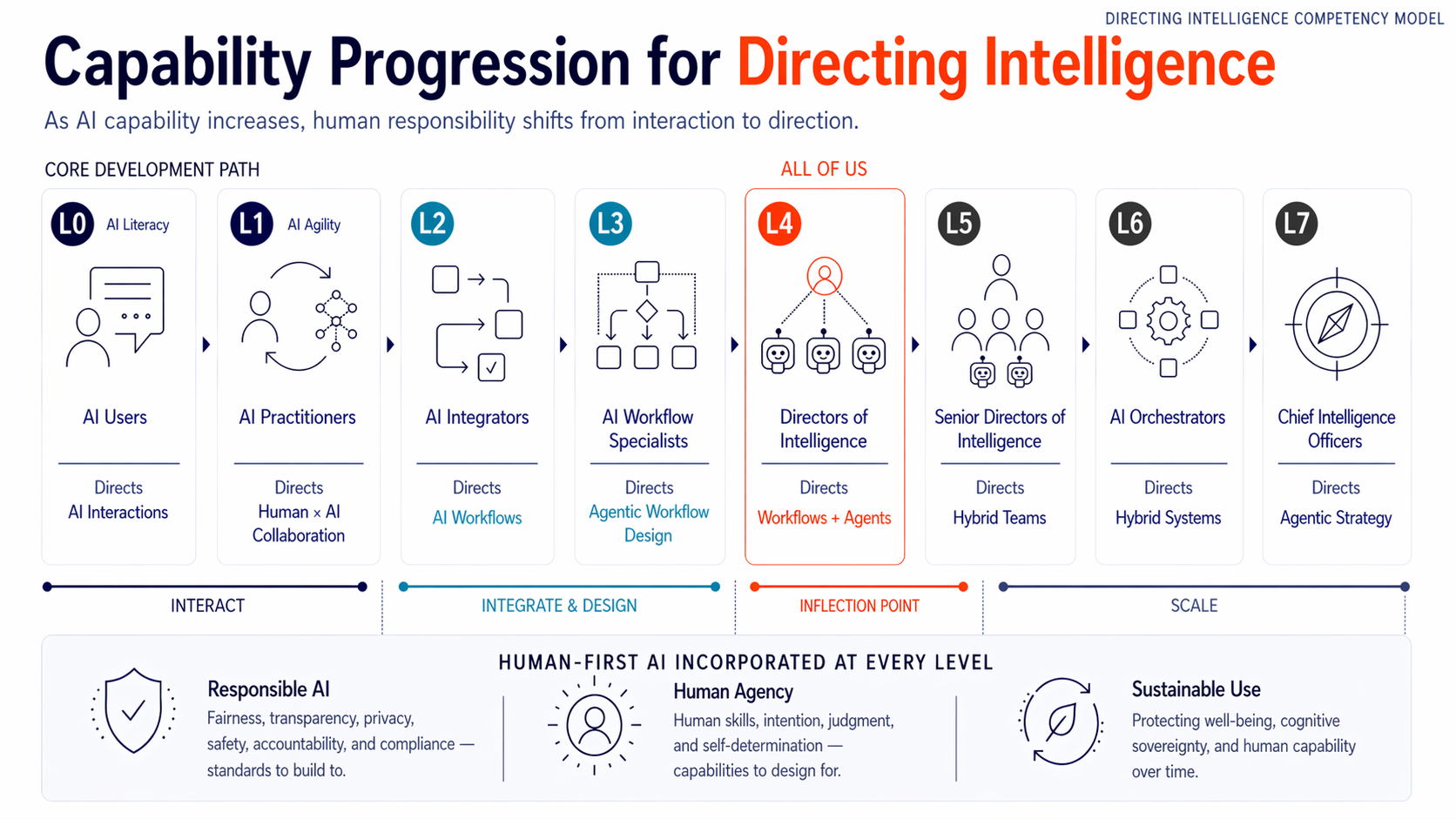
Capability Progression for Directing Intelligence: As AI Capability Increases, Human Responsibility Shifts to Direction
Eight levels, four phases, one through-line. L0 and L1 are the Interact phase: AI Users who direct interactions, AI Practitioners who direct human-AI collaboration. L2 and L3 are Integrate and Design: AI Integrators who direct workflows, AI Workflow Specialists who direct agentic workflow design. L4 is the inflection point and the level marked "all of us." Directors of Intelligence direct workflows and agents together. L5 through L7 is the Scale phase: Senior Directors of Intelligence running hybrid teams, AI Orchestrators running hybrid systems, Chief Intelligence Officers running agentic strategy. Underneath every level sit three constants: Responsible AI as the standard to build to, Human Agency as the capability to design for, Sustainable Use as the long horizon to protect. The progression is not about getting better at using AI. It is about taking on more of the directing as the tools take on more of the doing.
Now, We Are All Directing Intelligence
This isn't a job title. It's a description of what professional work has become. Every person with access to AI is now directing cognitive resources that didn't exist three years ago. The gap between people who recognize that and people who don't is already visible, and it's widening.
Vinod Khosla: "We've Rationed the Time of Our Most Expensive People"
Khosla names the constraint that shaped every workflow, org chart, and software purchase for decades: expert time was scarce, so everything was built to conserve it. AI dissolves that constraint. The workflows designed around rationing are still running, but the reason they were designed that way no longer holds.
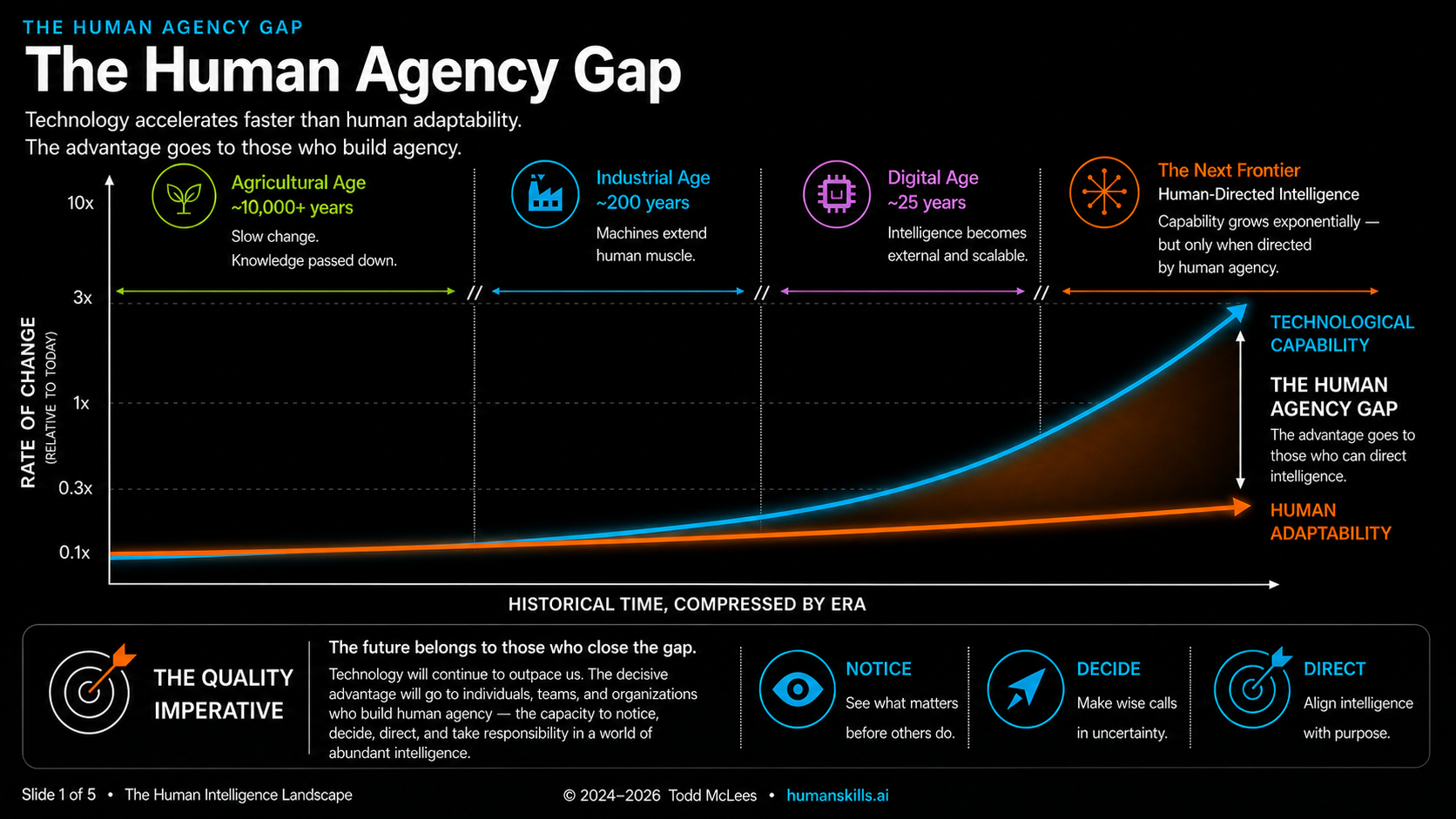
The Human Agency Gap: Technology Accelerates Faster Than Human Adaptability
Four eras on one timeline, compressed by speed. The Agricultural Age ran ten thousand years on slow change and inherited knowledge. The Industrial Age took two hundred to extend human muscle. The Digital Age took twenty-five to make intelligence external and scalable. The next frontier is human-directed intelligence, where capability grows exponentially but only when someone is actually directing it. The two curves on the chart tell the story. Technological capability bends sharply upward. Human adaptability rises gently. The widening space between them is the human agency gap, and it is where the advantage lives. The quality imperative underneath is simple: notice what matters, decide well in uncertainty, direct intelligence with purpose. Technology will keep outpacing us. The decisive edge goes to the people who close the distance.
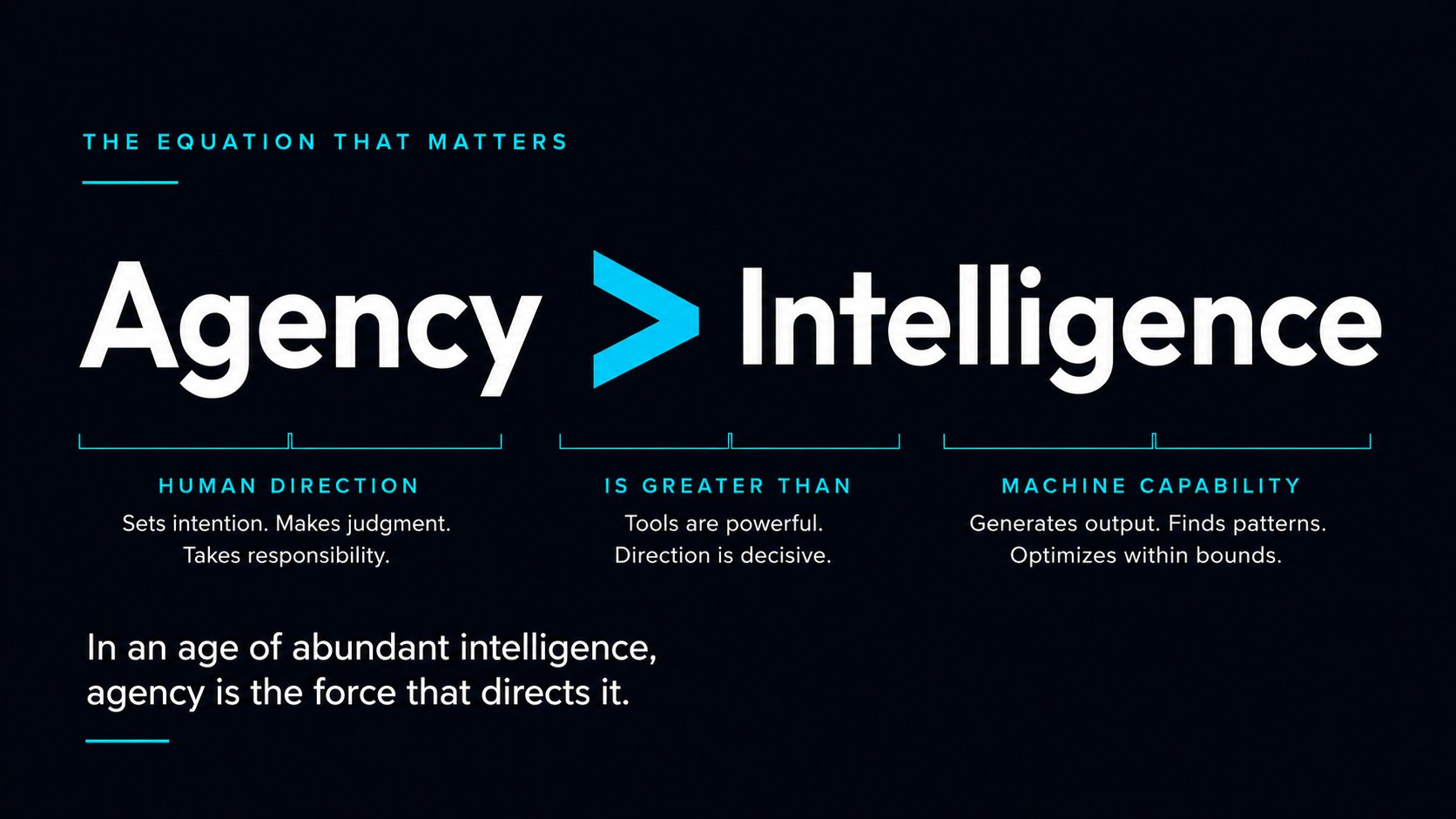
Agency > Intelligence: The Equation That Matters
One inequality, three definitions. Human direction sets intention, makes judgment, takes responsibility. Machine capability generates output, finds patterns, optimizes within bounds. The greater-than sign in the middle is the whole argument: tools are powerful, but direction is decisive. In an age of abundant intelligence, agency is the force that points it somewhere worth going.
Andrej Karpathy on Agency
One of the people who built these systems looked back at his own assumptions and concluded he had the hierarchy wrong for decades. Cultural obsession with IQ, with raw intellectual horsepower, obscured what actually drives outcomes. Agency is more powerful and more scarce than intelligence. Coming from someone who co-founded OpenAI and ran AI at Tesla, that's worth sitting with.
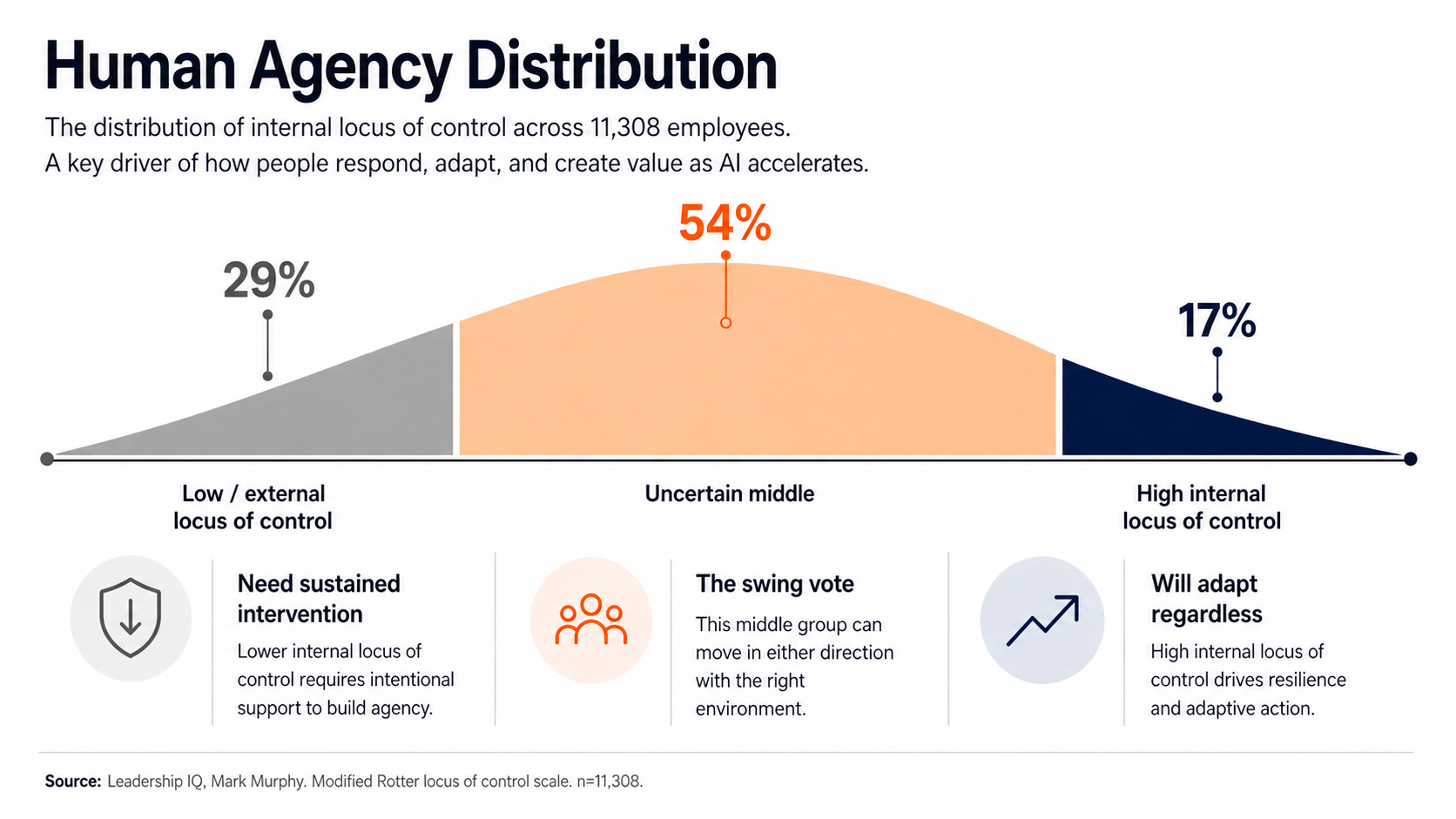
The Agency Distribution
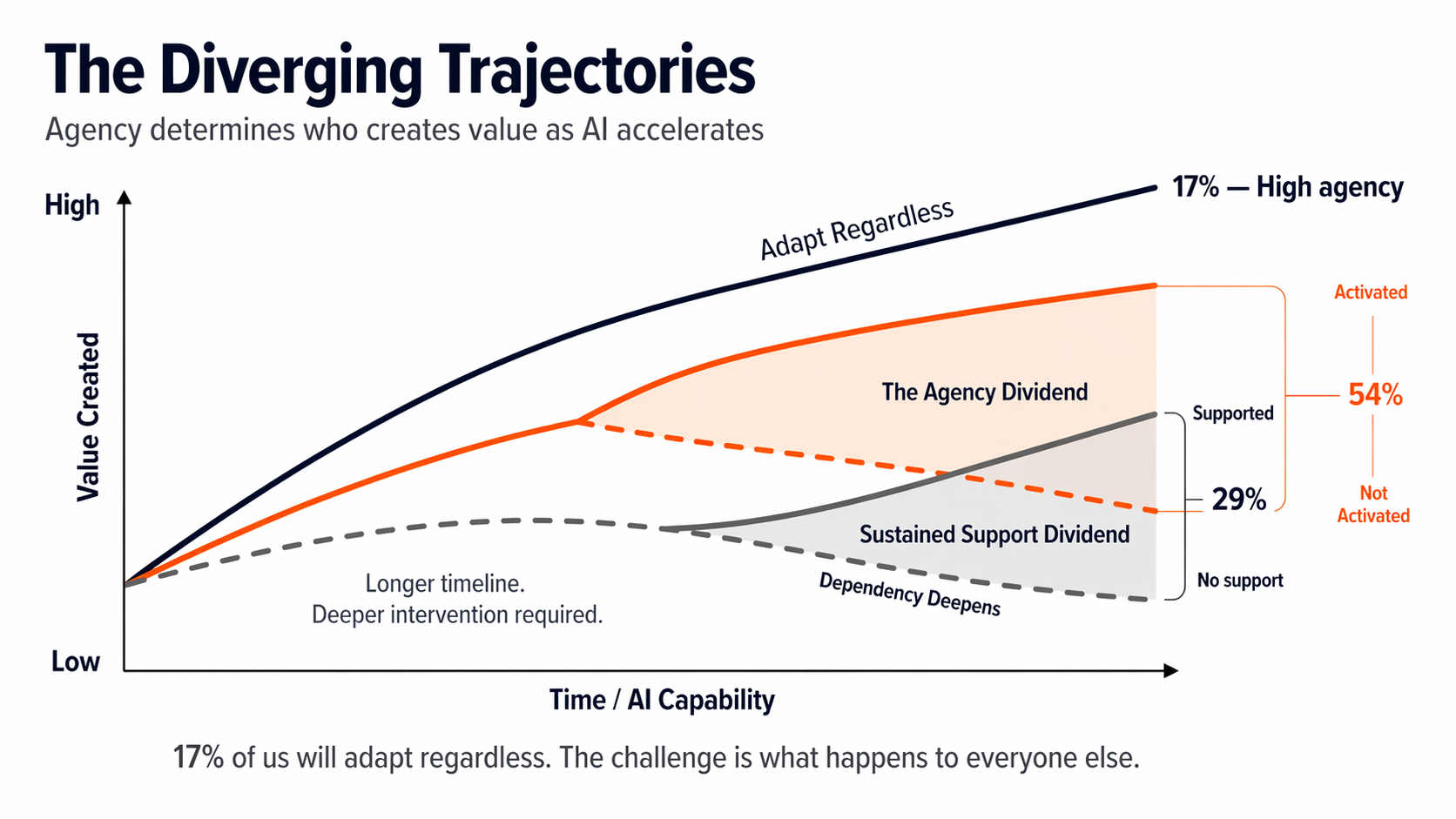
Across 11,308 employees, only 17% show a high internal locus of control. They'll adapt no matter what happens. Another 29% sit at the low end and need sustained intervention. The real story is the 54% in the middle: the uncertain majority whose trajectory depends almost entirely on the conditions their organization creates around them. That's where institutional investment pays off.
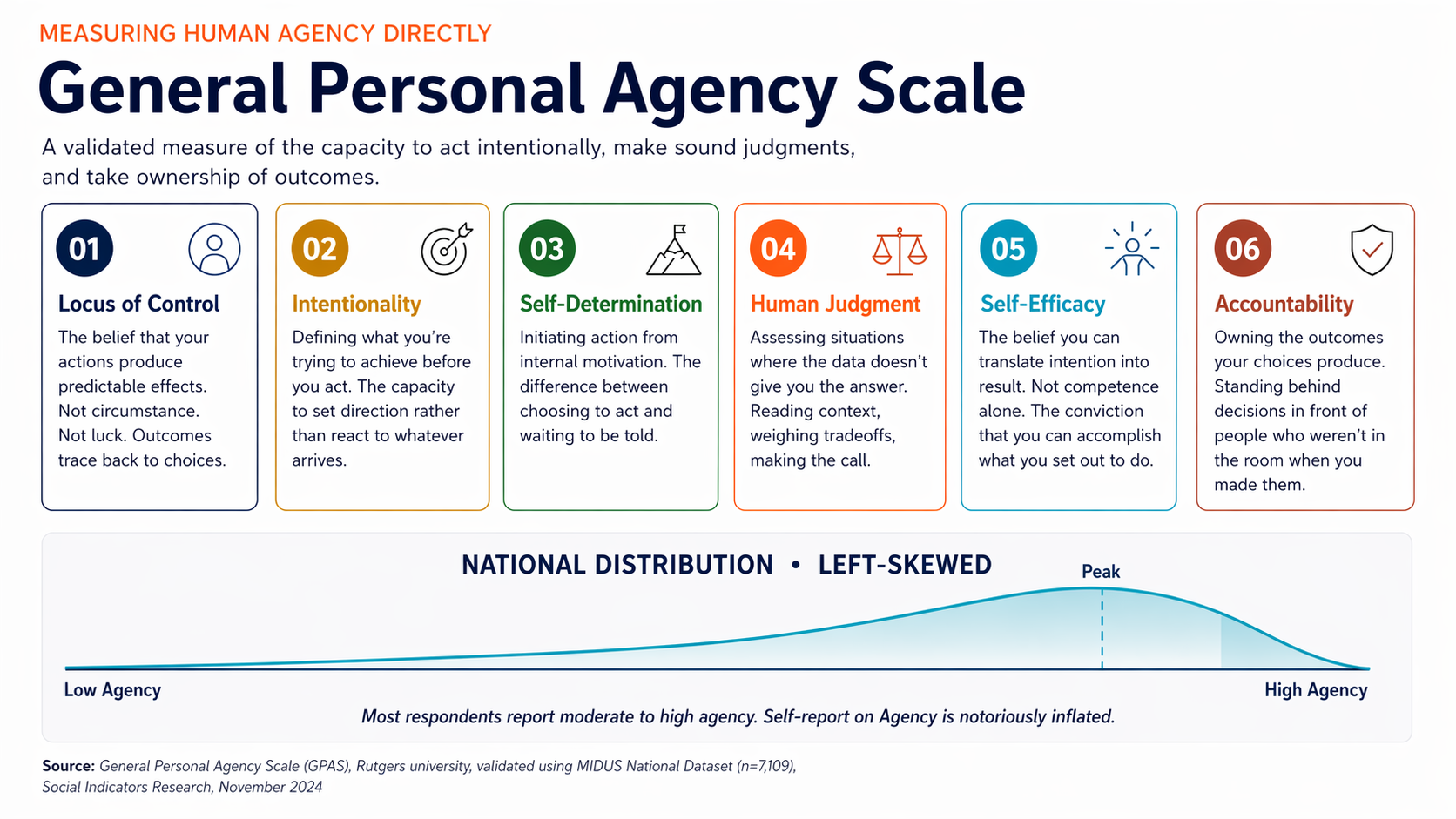
General Personal Agency Scale: Measuring Human Agency Directly
Agency isn't a vague concept. Rutgers validated a six-factor measurement instrument across 7,109 respondents: locus of control, intentionality, self-determination, human judgment, self-efficacy, and accountability. The national distribution skews left, meaning most people report moderate to high agency, but self-report is notoriously inflated. What matters for practitioners is that we now have a way to define, measure, and develop agency as a specific set of capacities rather than treating it as a personality trait you either have or don't.
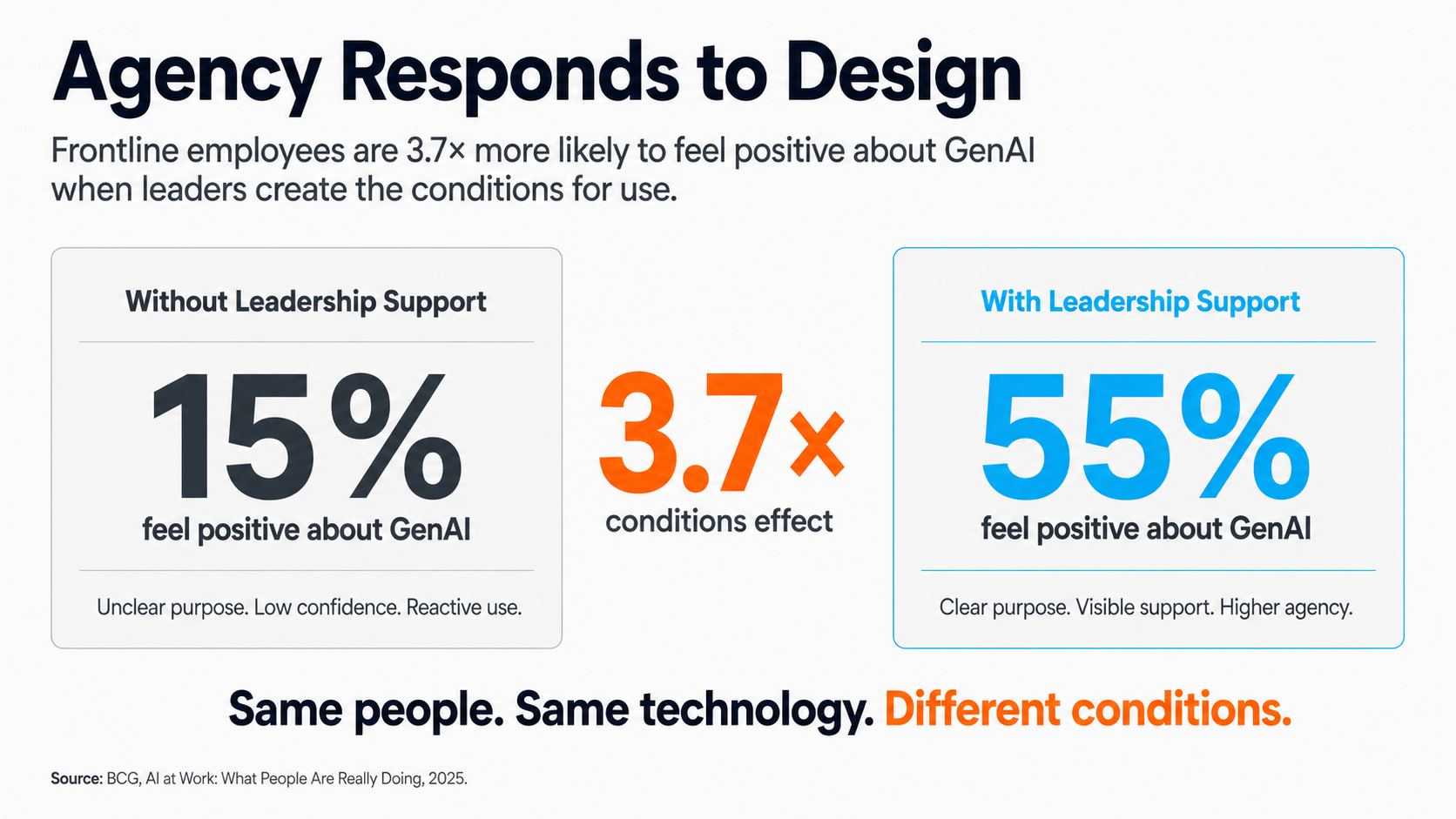
Agency Responds to Design
BCG found that 15% of frontline employees feel positive about generative AI when left to figure it out alone. With leadership support, that number jumps to 55%. Same people. Same technology. The only variable is the conditions around them. Agency isn't fixed. It responds to how organizations design the experience of change.
The Diverging Trajectories: Agency Determines Who Creates Value as AI Accelerates
Three paths, three outcomes. The 17% with high agency will adapt regardless. The 29% at the bottom face deepening dependency without sustained support. The 54% in the middle is where the leverage lives. With the right conditions, they activate and create an Agency Dividend that compounds over time. Without support, they drift toward dependency. The challenge for institutions isn't the top or the bottom. It's what happens to everyone else.
The Power of Inquiry to Spark Breakthrough Ideas
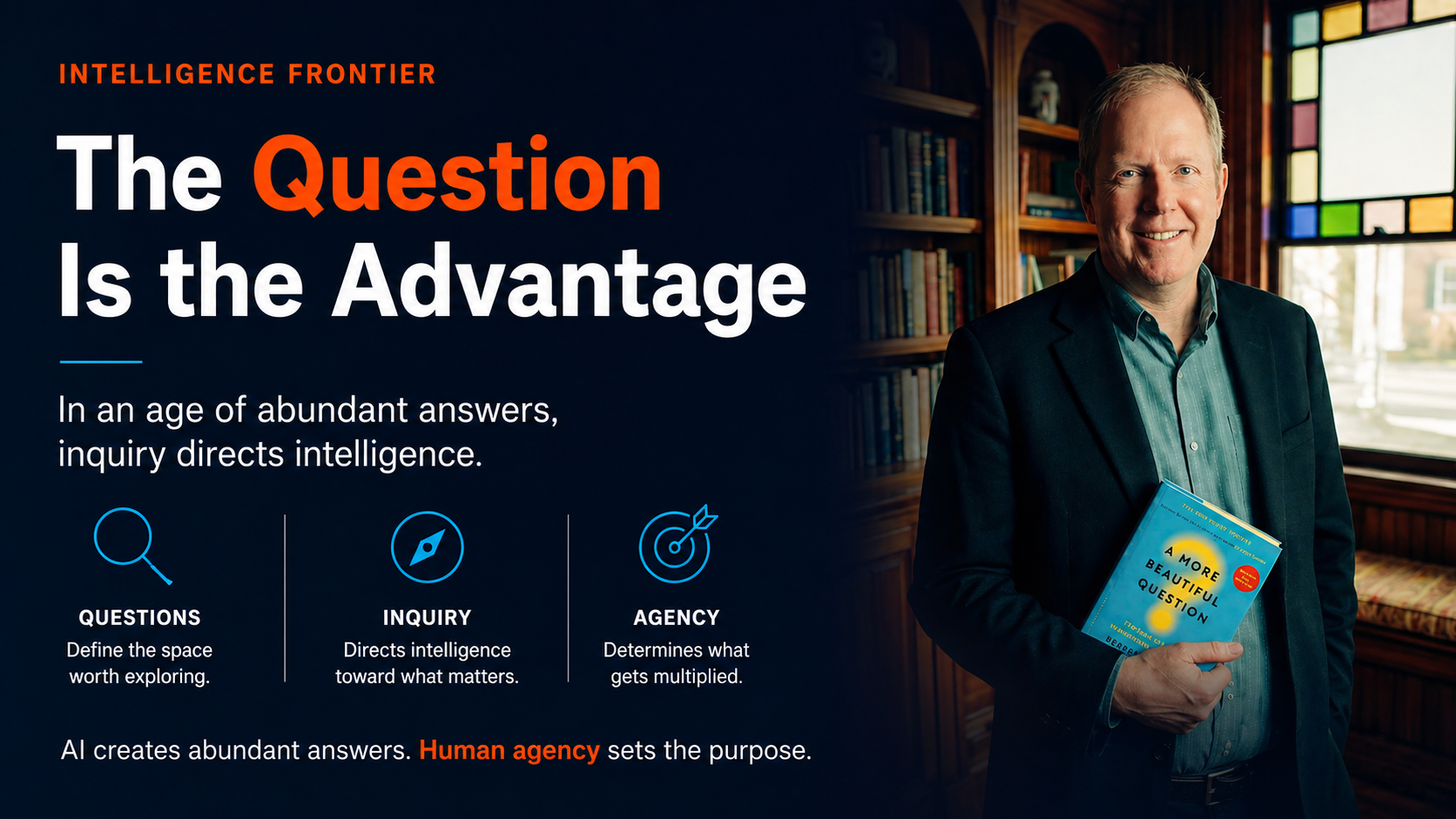
When answers are abundant and cheap, the person who asks the better question gets disproportionate results. Inquiry is becoming a professional skill, not a soft one. The ability to frame a problem well, to ask what hasn't been asked, matters more now than the ability to research an answer manually.
Intelligence Frontier: Thinking Beyond Displacement and Efficiency Strategies
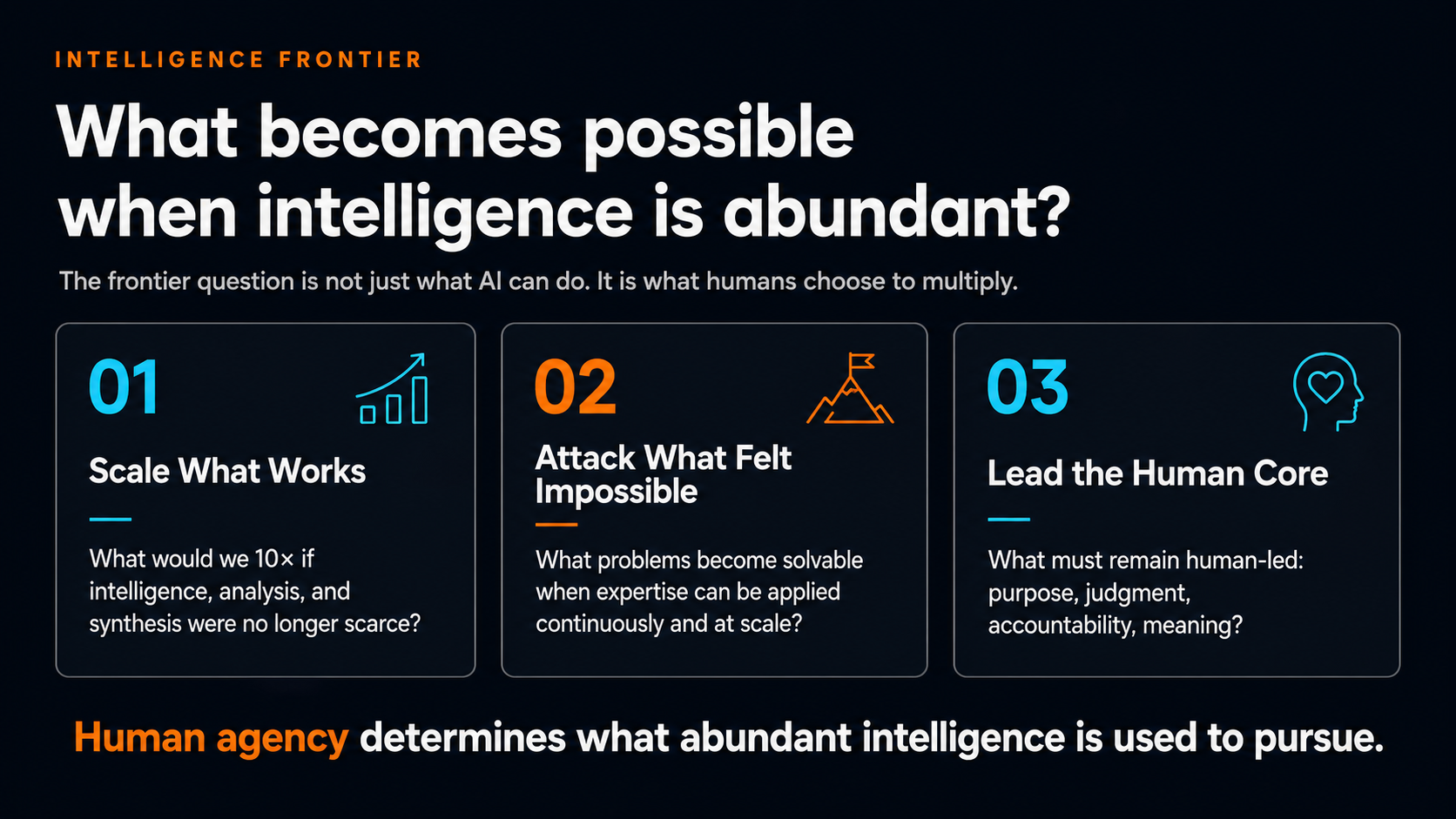
Most organizations are stuck asking how AI can make existing work faster or cheaper. That's the wrong altitude. The better questions: What's already working that you'd 10X if intelligence were unlimited? What problems feel impossible only because you can't hire enough talent to solve them? And the one that reframes everything: What are the things only humans can do, and how do you use abundant intelligence to multiply those?
We Are Lacking for Abundant Intelligence Use-Cases
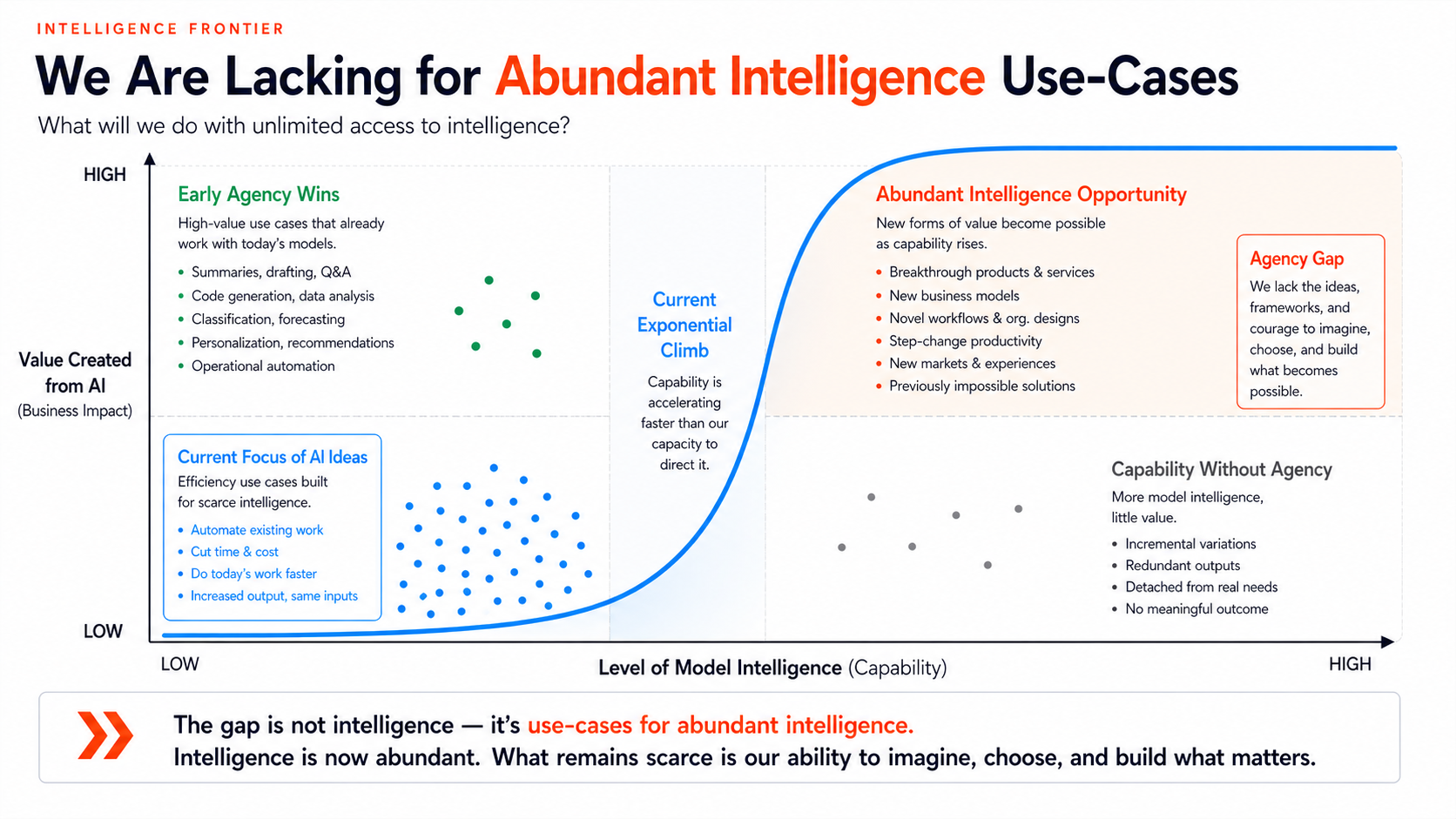
Most AI ideas are clustered around core use cases that require only moderate model intelligence. The biggest area of opportunity sits in the upper right of the chart, at the intelligence frontier, where more capable models unlock entirely new categories of value. The bottleneck isn't the technology. It's a lack of ideas about what to do with it.
Generative AI Value-Creation Pyramid
Four levels. Most organizations are stuck at level one: individual productivity improvements, quick wins, foundational skills. The real value lives higher up. Level two is collective intelligence, where AI becomes a team member and governance gets embedded. Level three redesigns core processes for abundant intelligence. Level four is visionary innovation, creating new markets and business models that weren't possible before. The shift from value capture (automating fast work) to value creation (augmenting slow work) is where most organizations stall.
Now We Are All Directing Intelligence: As AI Capability Increases, Human Responsibility Shifts to Direction
This is the same competency model as before, narrowed to the levels that apply to everyone. L0 AI Literacy and L1 AI Agility are the Interact phase, where AI Users direct interactions and AI Practitioners direct human-AI collaboration. L2 and L3 are Integrate and Design, where AI Integrators direct workflows and agents and AI Workflow Specialists direct agentic workflow design. L4 is the inflection point: Directors of Intelligence directing workflows and agents together. The senior and chief levels are not on this slide for a reason. The point of the title is that the directing work has moved down the org chart. It is no longer a specialist role at the top. It is the line every knowledge worker is now standing on. Underneath all of it, the same three constants: Responsible AI, Human Agency, Sustainable Use.
Andrew Ng on the Improtance of Workflows
The co-founder of Google Brain and Coursera sees the same pattern from the research side: the next wave of AI breakthroughs won't come from building bigger models. They'll come from how people design the workflows around them. The model is the ingredient. The workflow is the recipe.
David Solomon: "The Last 5% Now Matters Because the Rest Is Now a Commodity"
The CEO of Goldman Sachs is saying out loud what a lot of leaders are still processing quietly. When AI can produce 95% of the work, the differentiator shifts entirely to that final 5%: the judgment, the context, the taste, the accountability. That's where human value concentrates. And it's a very different skill set than producing the other 95% ever was.
Human Agency Scale: Opportunities for Human-AI Collaboration
A five-level scale from H1 to H5. H1 is autonomous AI with humans on alert. H2 is delegated AI with humans approving at milestones. H3 is shared agency in an iterative loop. H4 is augmented human agency, with AI expanding what the person can do. H5 is full human control. AI Drives on the left, Partnership in the middle, Human Drives on the right. Not a ranking, a set of choices.
Shao, Y., Zope, H., Jiang, Y., Pei, J., Nguyen, D., Brynjolfsson, E., and Yang, D. (2025). Future of Work with AI Agents: Auditing Automation and Augmentation Potential across the U.S. Workforce. arXiv:2506.06576. https://arxiv.org/abs/2506.06576
10 Stages to the Goldman Sachs S-1 Workflow
The S-1 filing process broken into ten phases, each mapped to a Human Agency level. Mandate and framing starts at H5, full human agency. Data assembly drops to H1, autonomous AI. Financial modeling sits at H2. The workflow oscillates across the entire scale depending on what each phase actually requires. This is what agentic workflow design looks like in practice: not one blanket decision about how much AI to use, but a deliberate call at every stage.
10 Stages to the Goldman Sachs S-1 Workflow
A real workflow plotted across the scale. Mandate and framing sits at H5, full human judgment. Data assembly drops to H1, fully automated. Financial modeling rises to H2, narrative draft to H3. Risk and compliance comes back down to H1. Internal review, regulator interaction, investor roadshow, and pricing climb back through H3 and H4 as human judgment reasserts itself. Post-mortem closes at H5. One process, ten steps, every level of the scale in play. The point is that no single H-level fits a real job. The work is choreography.
Goldman Sachs S-1 Workflow: Human Agency Task Time Distribution
When you look at where the actual time goes, 60% of the workflow runs at H1, fully autonomous AI. Another 15% sits at H2, delegated AI agency. Only 15% of total task time requires H5 or H4 levels of human involvement. Solomon's "last 5%" lands differently when you see it mapped: a small fraction of the total workflow carries almost all of the judgment, accountability, and reputational weight.
Scaffolding AI into Learning
A section divider. The image carries the idea: small figures climbing scaffolding inside the outline of a human head, building upward together. The next stretch of slides moves from the broader case for directing intelligence into the specific question of how AI gets built into the way people actually learn.
Instructor Control of AI in the Classroom: A Faculty-Led Progression for Assessment
Four lanes of academic freedom, set by the instructor for each assignment. AI-Required puts AI in the workflow with clear expectations for student oversight and final approval. AI-Encouraged promotes AI as a support while students retain ownership of the final work. AI-Optional leaves the choice to the student, with transparent disclosure. Purely Human is AI-Forbidden, the protected zone where independent performance validates mastery. Each lane defines a faculty role, a student role, a leadership signal, and a set of examples. The framework codifies faculty authority. Instructors decide when AI is excluded, optional, encouraged, or required, and that decision is what protects rigor and academic freedom at the same time.
AI Roles Mapped to Human Agency: Faculty Determine the Role, H-Level Sets the Boundary
The same scale, applied to the classroom. H1 anchors the left side as fully autonomous AI, H5 anchors the right as purely human, and three working zones sit between them. AI-Led at H2 is primarily AI-owned, with the human supervising, auditing, and setting constraints. AI-Augmented at H3 to H4 is shared creation with frequent handoffs, where the student leads the key decisions. AI-Assisted at H4 is human-owned work with AI giving feedback, checks, or micro-tasks. Each zone carries concrete examples, from adaptive quizzing to co-designed assignments to grammar checks and study aids. Classroom work will keep shifting toward AI-powered approaches over time. What faculty hold onto is the call about whether AI shows up as a shortcut, a scaffold, or a partner.
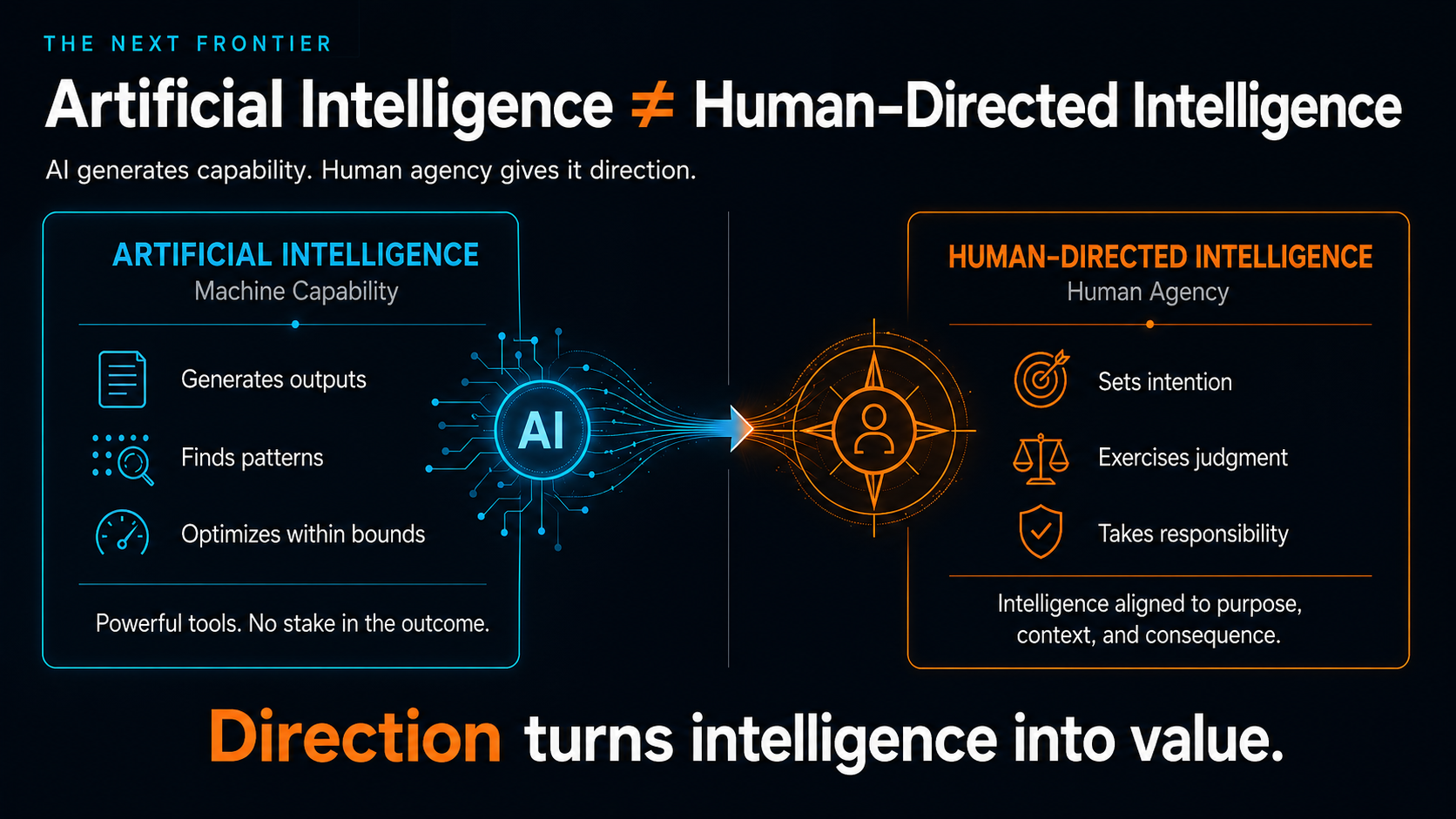
Artificial Intelligence ≠ Human-Directed Intelligence: AI Generates Capability. Human Agency Gives It Direction.
Two columns, one inequality. On the left, machine capability generates outputs, finds patterns, optimizes within bounds. Powerful tools, no stake in the outcome. On the right, human agency sets intention, exercises judgment, takes responsibility. Intelligence aligned to purpose, context, and consequence. The gap between them is the whole point. Direction is what turns intelligence into value.
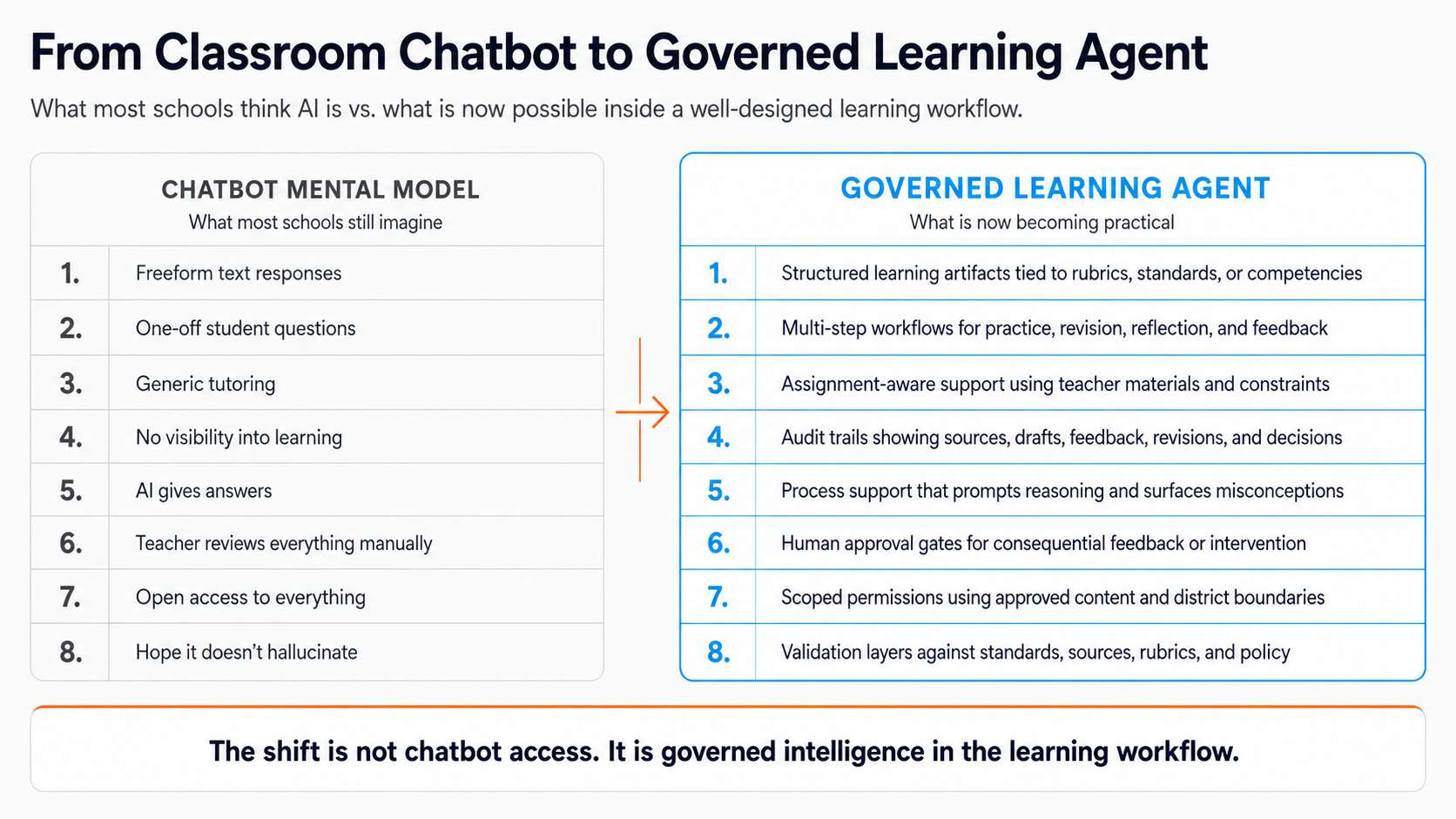
From Classroom Chatbot to Governed Learning Agent: What Is Now Possible Inside a Well-Designed Learning Workflow
The same chatbot-versus-governed-agent contrast from earlier, applied to education. The chatbot mental model on the left is what most schools still imagine: freeform text responses, one-off student questions, generic tutoring, no visibility into learning, AI giving answers, teachers reviewing everything manually, open access, and the hope it does not hallucinate. The governed learning agent on the right is what is now becoming practical: structured learning artifacts tied to rubrics, multi-step workflows for practice and revision, assignment-aware support using teacher materials, audit trails, process support that prompts reasoning, human approval gates for consequential feedback, scoped permissions inside district boundaries, and validation layers against standards and policy. The shift is not chatbot access. It is governed intelligence inside the learning workflow.
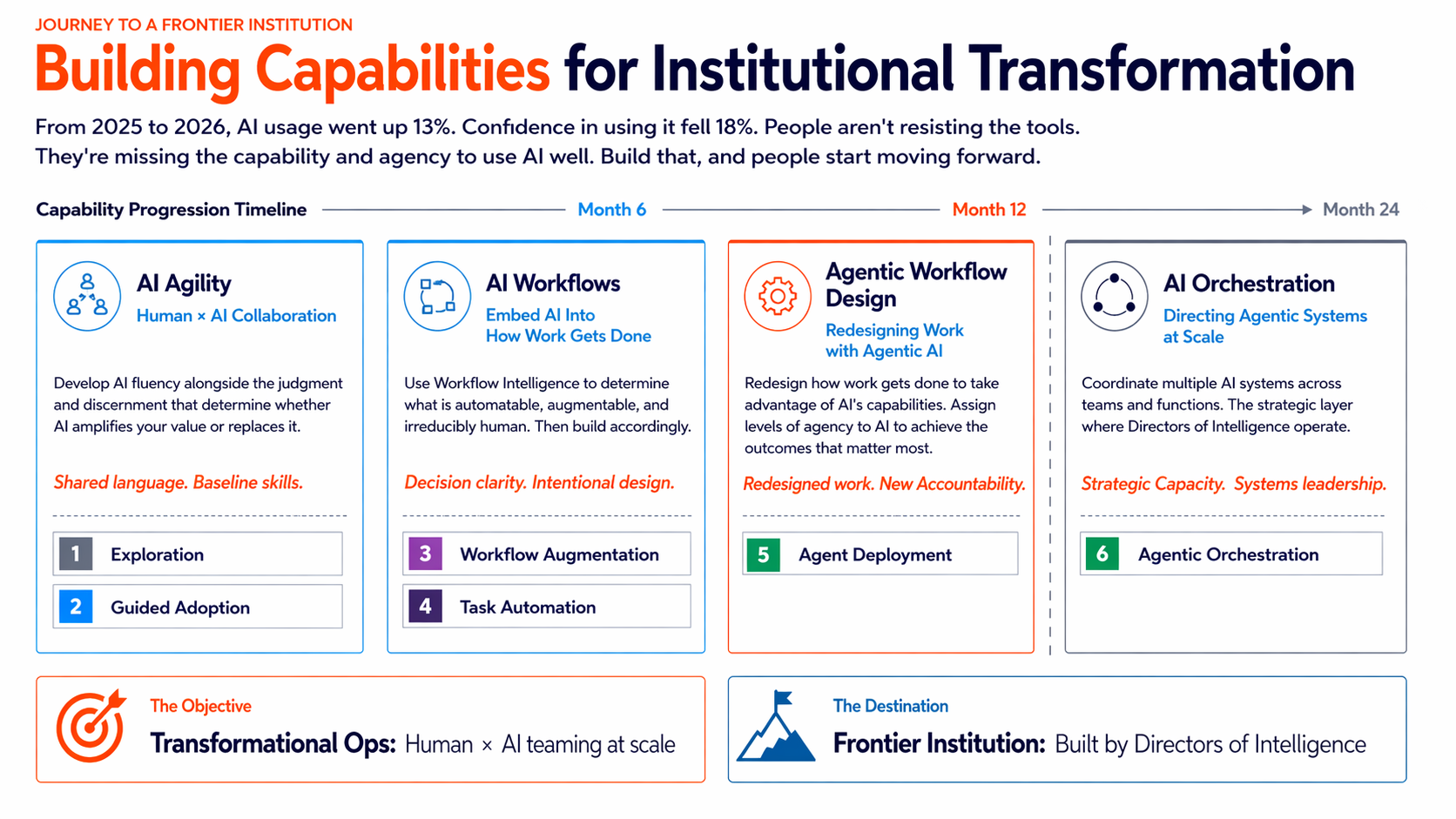
Building Capabilities for Institutional Transformation: The Journey to a Frontier Institution
A 24-month progression with a sharp diagnostic on top: AI usage went up 13 percent from 2025 to 2026, and confidence in using it fell 18 percent. The gap is not resistance to the tools. It is a missing capability and a missing sense of agency. The timeline lays out four stages. AI Agility builds human-AI collaboration through exploration and guided adoption, the shared language and baseline skills phase. AI Workflows embeds AI into how work gets done through workflow augmentation and task automation, the decision-clarity phase. Agentic Workflow Design redesigns work itself by assigning levels of agency to AI, the redesigned-work and new-accountability phase. AI Orchestration coordinates multiple AI systems across teams and functions, the strategic capacity layer where Directors of Intelligence operate. The objective along the way is transformational ops, human-AI teaming at scale. The destination is a frontier institution, built by the people who learned to direct.