Titan 100 Event: Directing Intelligence
Keynote Slides
Copyright © 2026 | humanskills.ai LLC. | All Rights Reserved
Directing Intelligence: The New Scarce Skill
Intelligence is no longer the scarce resource. AI has made it abundant, accessible, and increasingly cheap. What's scarce now is the human capacity to direct it well. The professional advantage going forward isn't knowing more or working faster. It's knowing what to point intelligence at, when to trust it, and when to override it. That's agency. And developing it is a skill, not a personality trait.
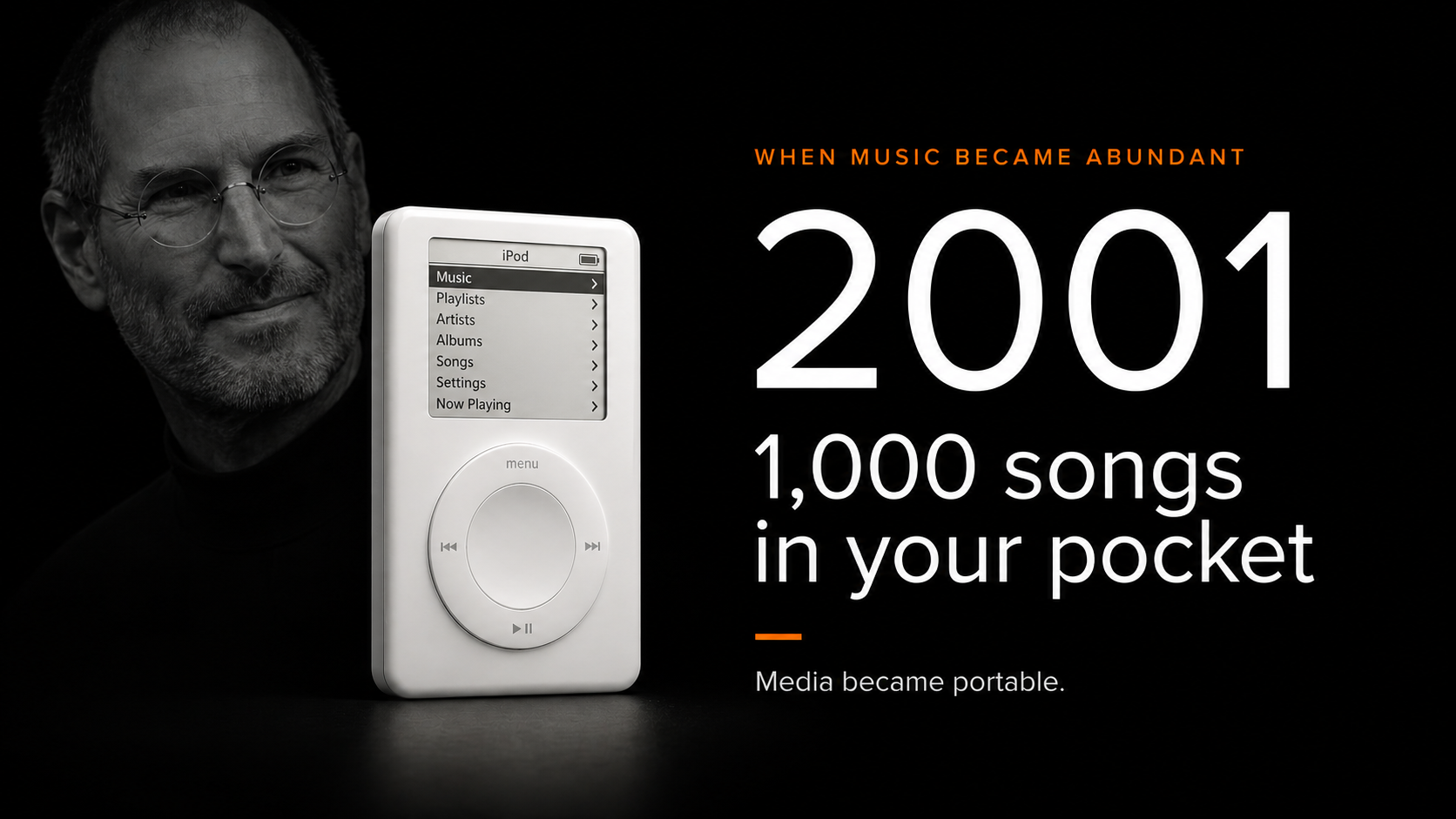
2001: 1,000 Songs in Your Pocket
25 years ago, Apple put your entire music library on a device that fit in your hand. At the time, that felt like the biggest thing abundance could mean.
When Will Top Quartile Human Performance Be Achieved with AI?
In 2017, experts placed most AI milestones decades out. By 2023, those same timelines had collapsed by 20 to 40 years. Natural language generation, pattern recognition, sensory perception...these are capabilities that were supposed to be a generation away are here now.
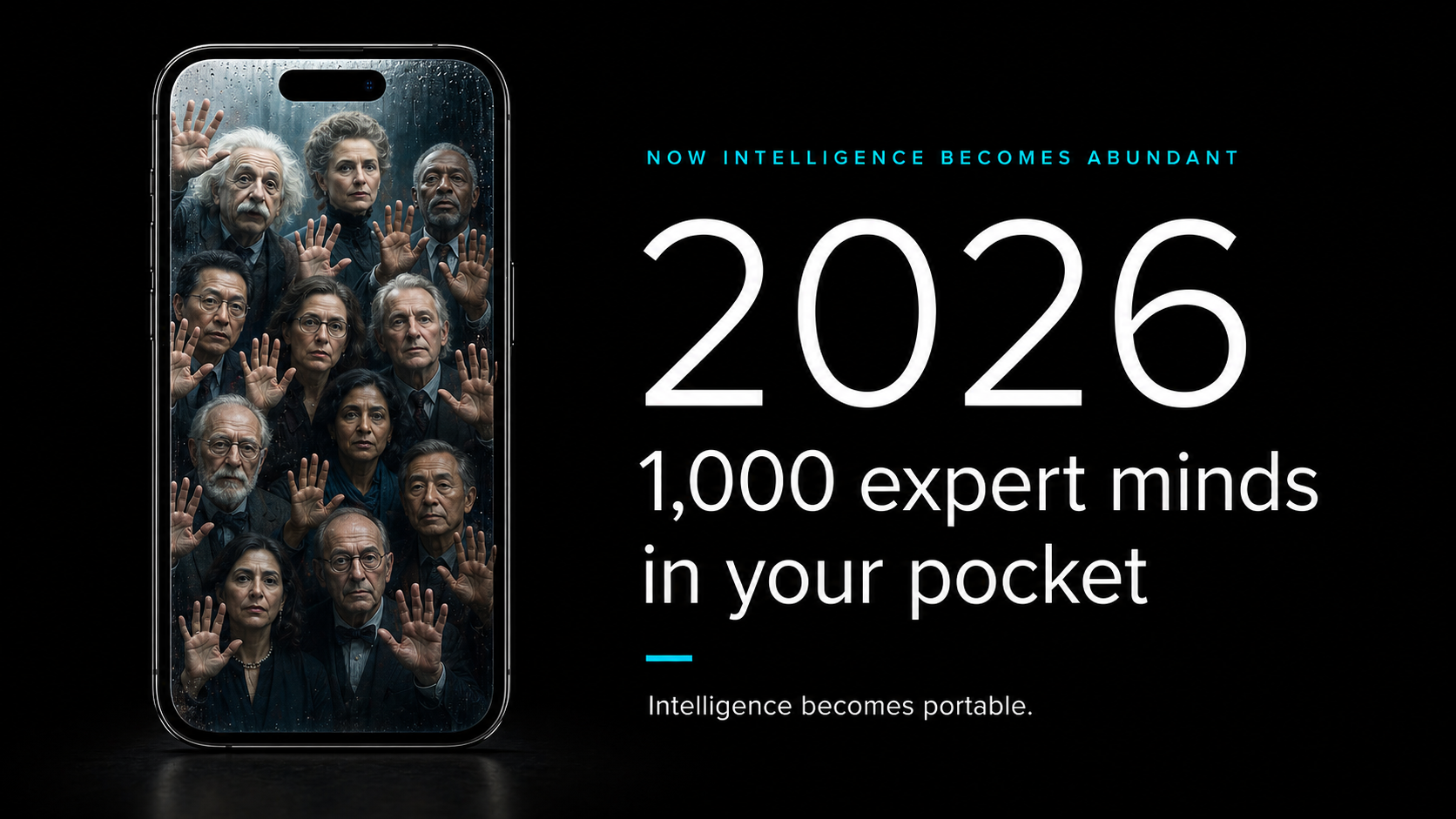
2026: 1,000 Expert Minds in Your Pocket
Now the AI companies are promising that the same device gives you access to PhD-level reasoning across virtually every discipline, on demand, for a monthly subscription. The question the music industry had to answer after the iPod applies to every knowledge profession now: once access to intelligence is no longer the bottleneck, what actually becomes valuable?
Situational Awareness: Plan for Tomorrow's AI
AI capabilities are changing faster than most institutional planning cycles can absorb. This section looks at what's coming next so you can build strategy that holds up even as the technology underneath it keeps moving.
December 2024: Where the Machines Started
Seventeen months ago, the most capable AI systems on the market scored in the below-average to low-average range on standardized intelligence tests. The frontier model of the day sat just below the median human. For most of computing's history, that's where the story would have ended: faster tools, narrow gains, nothing resembling a thinking peer. This is the chart. The next slide is the same chart, seventeen months later
May 2026: Past the Genius Line
Same chart. Seventeen months. The models have moved from the left half of the curve to the right tail, and several have run out of test to take. The Mensa Norway assessment caps at 145, and a handful of frontier systems now sit at that ceiling. The point of this slide isn't that machines are smarter than people. It's that the instrument we've used for a century to rank human intelligence no longer has enough room for the thing it was built to measure. Once intelligence-as-measured becomes a commodity, the question every knowledge profession has to answer changes shape: not "can the tool think?" but "what's still mine to do?"
What Does It Mean When AI Scores >140 on a Mensa IQ Test?
In 2024, leading AI systems scored in the average human range. In 2025, they hit 145, the ceiling of the Mensa Norway instrument. The 2026 projection of 175 isn't measured. It's extrapolated past the top of the test, because the test has nowhere left to go. That's the quieter signal in this chart: the standardized way we've measured intelligence for a century is no longer the right yardstick for what we're measuring. Genius is now something you can rent on a monthly subscription. Which makes the strategic question for every knowledge profession less about whether AI is capable enough, and more about what's left that depends on you being in the room.
After Abundance
The prior slides showed intelligence becoming abundant. This is where the argument turns. When something becomes cheap, what's left to compete on is whatever the cheap thing depends on. Intelligence depends on someone choosing what to point it at, deciding what to delegate and what to hold, and bearing the consequences when the decisions land. That is human agency. It does not scale with compute, and it does not improve by adding more models. It sits structurally beneath every AI-augmented workflow, which is why the framework on the next slide starts there and not with the tools.
The Line That Keeps Moving
Intelligence decomposes into roughly thirty distinct capabilities, each on its own commoditization timeline. The three zones on this slide are a snapshot, not a taxonomy. Visual pattern recognition and logical-mathematical reasoning crossed from the middle column to the left column inside the last twelve months. Fluid reasoning on novel problems is crossing now. Two operating implications. First, treating intelligence as one thing produces strategies that age badly inside a year. Second, the capabilities in the right column do not get easier to hold just because the left column expands. The developmental note at the bottom is the quieter point worth carrying. When AI commoditizes outputs, the temptation is to skip developing the underlying cognition. The research now coming in suggests that is the wrong move.
What Makes the Flywheel Compound
More capable AI by itself does not produce more value. It produces more output. The slide names the missing variable in most of the current AI discourse: someone has to be directing where the capability gets pointed. Purpose, values, judgment, accountability, the items on the left side of this diagram, are not soft skills layered on top of the technology. They are the operating inputs that decide whether the flywheel produces breakthrough discoveries or impressive-looking noise. Strip the human agency column out, and the diagram still works mechanically. It just stops compounding in any direction worth going.
What Fei-Fei Li Is Actually Claiming
Read past the optimism in the quote, and there is a specific technical claim underneath. Fei-Fei Li is not saying collaboration is one good option. She is saying it is the most productive one. More productive than full automation. More productive than humans working alone. She built ImageNet, founded Stanford's Human-Centered AI Institute, and runs her current company today. She has been inside this field for two decades and has stayed measured through every cycle of hype. When her read of the productivity frontier comes back as collaboration, that is not aspirational language. It is an engineering observation, and it tells you where the operating leverage actually sits.
The Streams, Not the Curve
Most AI discourse treats capability as a single curve heading up and to the right. The picture is closer to what this slide shows. Multiple capability streams running on different timelines, combining into new systems that look discontinuous from the outside. The four sections that follow read the streams from different angles. What each capability actually means. How the streams combine into something more than the sum. What the convergence is already producing in the world. And where human judgment still decides whether any of it matters. The strategic question at the bottom of the slide is the one to hold across all four. Visible, reliable, and essential are different things, and the people who can tell which is which are the ones who can plan.
Six Projected Breakthroughs for 2026: What AI's Architects Say Will Come Next
These are not skeptics. Hassabis, Altman, Amodei, and Suleyman are running the four most consequential AI labs in operation, and this is their own list of what current language models cannot yet do well. Read across the rows. Reliability is the consensus priority. Long-term memory and long-horizon reasoning are widely shared. Social intelligence is the gap almost no one is leading on. Then read what is not on the list. Judgment that bears consequences. Accountability for outcomes. Meaning. Purpose. The list the builders are working on is the list of capabilities AI is trying to acquire. The list the builders are not working on is the list of capabilities the humans in the room still own.
The Convergence of AI Capability - Reading the Diagonal
Capabilities do not arrive on the same schedule. Language and multimodal perception are already at reliable scale in 2026. Reasoning, agentic use, and world models are in bounded deployment. Physical and spatial AI are still productizing in structured settings. That uneven movement is the structural feature of this market, and most strategic mistakes happen when leaders treat it as a single curve and bet on a single date. The enabling-foundation row at the bottom is the quieter signal. Data, model architecture, compute, and governance set the actual ceiling on how fast any of the seven frontiers above can move. The strategic shift named at the bottom of the slide is what is left after the chart is read honestly. The advantage will go to people who know what to build now, what to wait on, and what to keep human regardless of how the timeline plays out.
The Human x AI Partnership: Our Work is in the Far-Right Column
Read the rows. AI generates, sees, reasons, acts, simulates, operates physically, accelerates discovery. Each row also has a human side. Set meaning. Notice what matters. Decide and challenge. Direct goals. Choose assumptions. Govern autonomy. Frame the question. The right column is not the soft skills layered onto the technical work. It is the work. The technical capabilities on the left will keep improving, and faster than this chart can be redrawn. The capabilities on the right are what stays yours regardless of which model is running underneath. Which is why the closing line of the slide is the strategic frame the whole deck rests on. What to direct, what to delegate, what to verify, and what to keep human is the operating standard for working in the Agency Economy.
Three Eras of Agent Capability: From Demos to Frameworks to Governed Agents
Agents have moved through three distinct stages in three years, and the gap between each one is bigger than it looks. The Demo Era of 2023–2024 was prompt loops with tool access, no structured outputs, no governance, errors compounding at every step, nothing you could put in front of a real user. The Framework Era of 2025 brought LangGraph, CrewAI, and serious enterprise interest, with 60–70 percent of enterprises experimenting but only 15–20 percent reaching production. Reliability and governance gaps blocked deployment. Late 2025 into 2026 is the era of governed agents: schema-enforced outputs, human-approval gates, full audit trails, scoped permissions, production-ready for real users. The technical story is one of maturity. The human story underneath it is the same arc as the previous slide. Asking well, designing well, directing well. The agents got governable. The question is whether the people working with them learned to direct what now actually deploys.
What Changed in the Last Six Months: Eight Capabilities That Make Governed Agentic Learning Possible
The shift to governed agents was not one breakthrough. It was eight, and they all landed inside a six-month window. Permission before action means agents must ask before doing anything consequential. Scoped permissions limit them to what is explicitly authorized. Structured responses replace freeform text with schema-enforced outputs. Capability discovery lets agents find tools through standardized descriptions. Full audit trails make every action traceable. Session continuity holds context across modules and days. Background execution allows long-running tasks with async check-back. Domain extensions provide standard patterns for education, healthcare, finance, and more. Each one is a prerequisite for Virgil, and none of them existed in production form before late 2025. Together they turn AI from a tool into governed learning infrastructure. The capability stack underneath agentic learning was rebuilt in a single half-year.
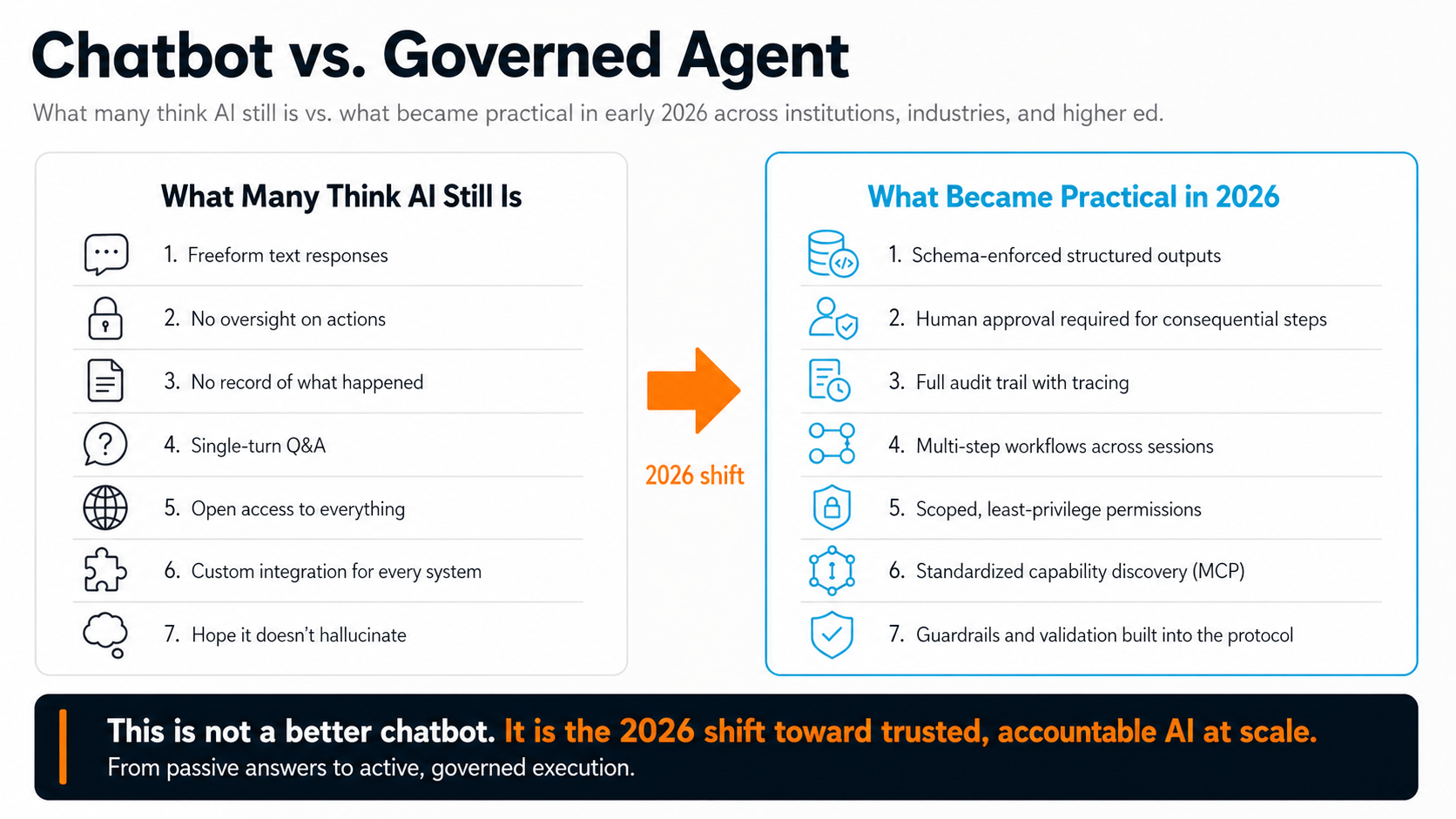
Chatbot vs. Governed Agent:
What Many Think AI Still Is vs. What Became Practical in 2026Most people are still working with a mental model that ended a year ago. They picture AI as freeform text responses, no oversight on actions, no record of what happened, single-turn Q&A, open access to everything, custom integration for every system, and the quiet hope that it does not hallucinate. What became practical across institutions and industries in early 2026 is a different category of system: schema-enforced structured outputs, human approval required for consequential steps, full audit trail with tracing, multi-step workflows across sessions, scoped least-privilege permissions, standardized capability discovery through MCP, and guardrails built into the protocol itself. This is not a better chatbot. It is the shift from passive answers to active, governed execution. The gap between the two columns is where most organizations are still operating, and it is also where the next eighteen months of competitive separation will happen.
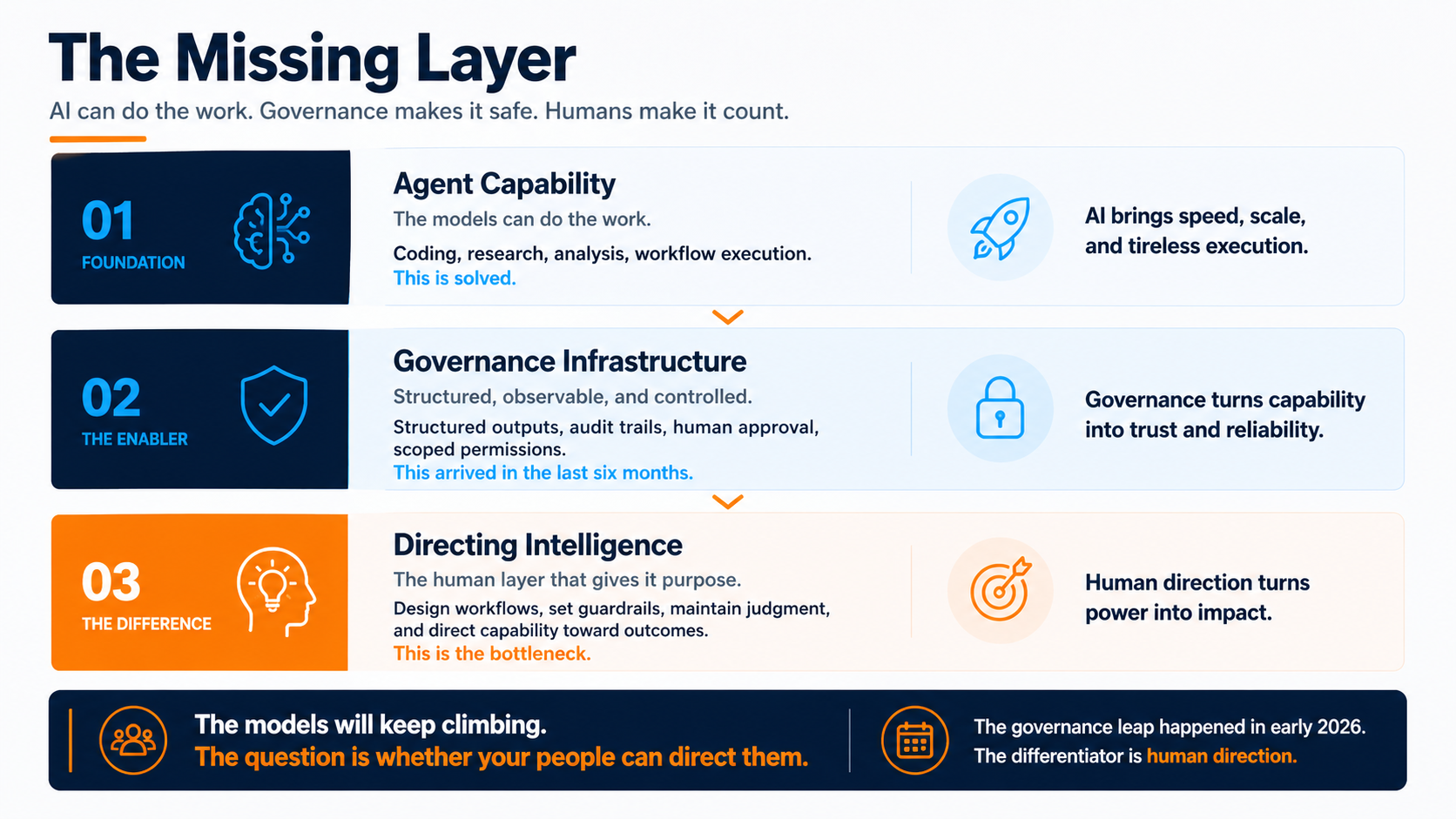
The Missing Layer:
AI Can Do the Work. Governance Makes It Safe. Humans Make It Count.Three layers, and only one of them is still in question. Agent capability is the foundation, and it is solved. Coding, research, analysis, workflow execution, all running at speed and scale. Governance infrastructure is the enabler, and it arrived in the last six months. Structured outputs, audit trails, human approval, scoped permissions. The third layer is directing intelligence, the human work of designing workflows, setting guardrails, maintaining judgment, and pointing capability at outcomes that matter. That is the bottleneck. The models will keep climbing. The governance leap already happened. The differentiator now is whether the people inside an organization can actually direct what the system can do.
When the Headlines Stop Helping
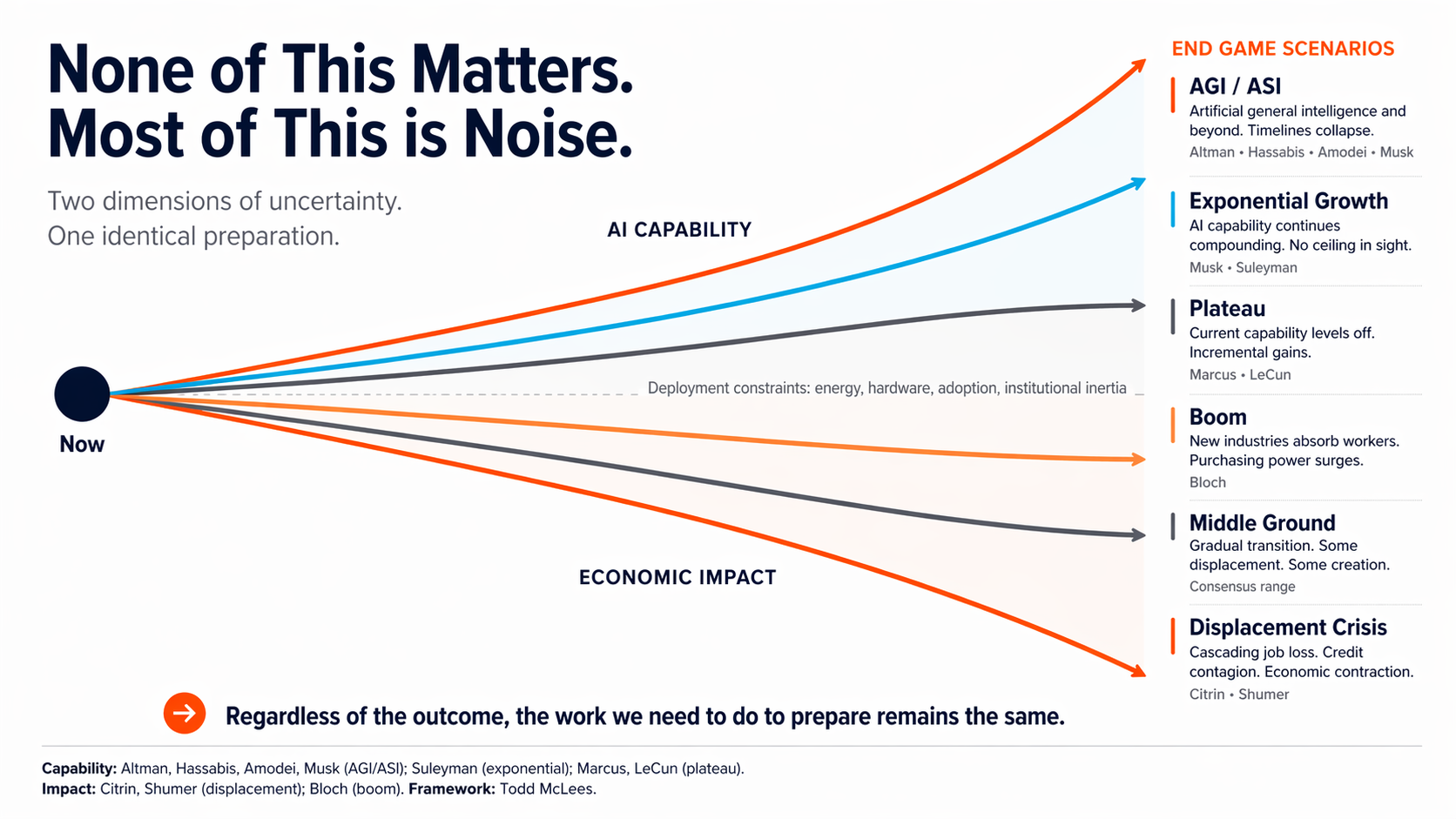
Both columns are true. The left side describes what is happening to people right now, which is real, and worth feeling. The right side describes what is being built, which is real, and worth tracking. Neither side tells you what to plan for, because the news cycle and the planning horizon run on different clocks. The slide's own diagnosis is the one worth holding: intelligence is becoming abundant faster than the institutions designed to absorb it. Which makes the operational question the next slide poses worth taking seriously. What would be worth doing in every scenario, including the ones nobody is currently predicting?
Invariant Preparation
Six futures, six commentators, six contradictory bets. The framework's quiet power is what it does to the planning question. If you cannot tell which scenario lands, the move is not to pick one. The move is to find the things that pay off in all of them and build there. Human agency pays off in every column. Judgment, accountability, and the capacity to direct intelligence toward outcomes worth pursuing compound whether AI plateaus or runs to AGI, whether the economy booms or absorbs a displacement crisis. Invariant preparation is the strategic move available right now. It is also the only one that does not require betting on an outcome no one in this list of names actually knows.
The Missing Middle: The 18-Month Window of Opportunity
The previous section ended with invariant preparation. This section names the window where that preparation has to happen. Most AI discourse lives at the extremes. The doom commentary describes outcomes five to ten years out. The boom commentary describes outcomes five to ten years out. The middle, where actual leaders have to make actual decisions inside the next six quarters, is largely empty. That gap is the opportunity. The next slides describe what to do inside it.
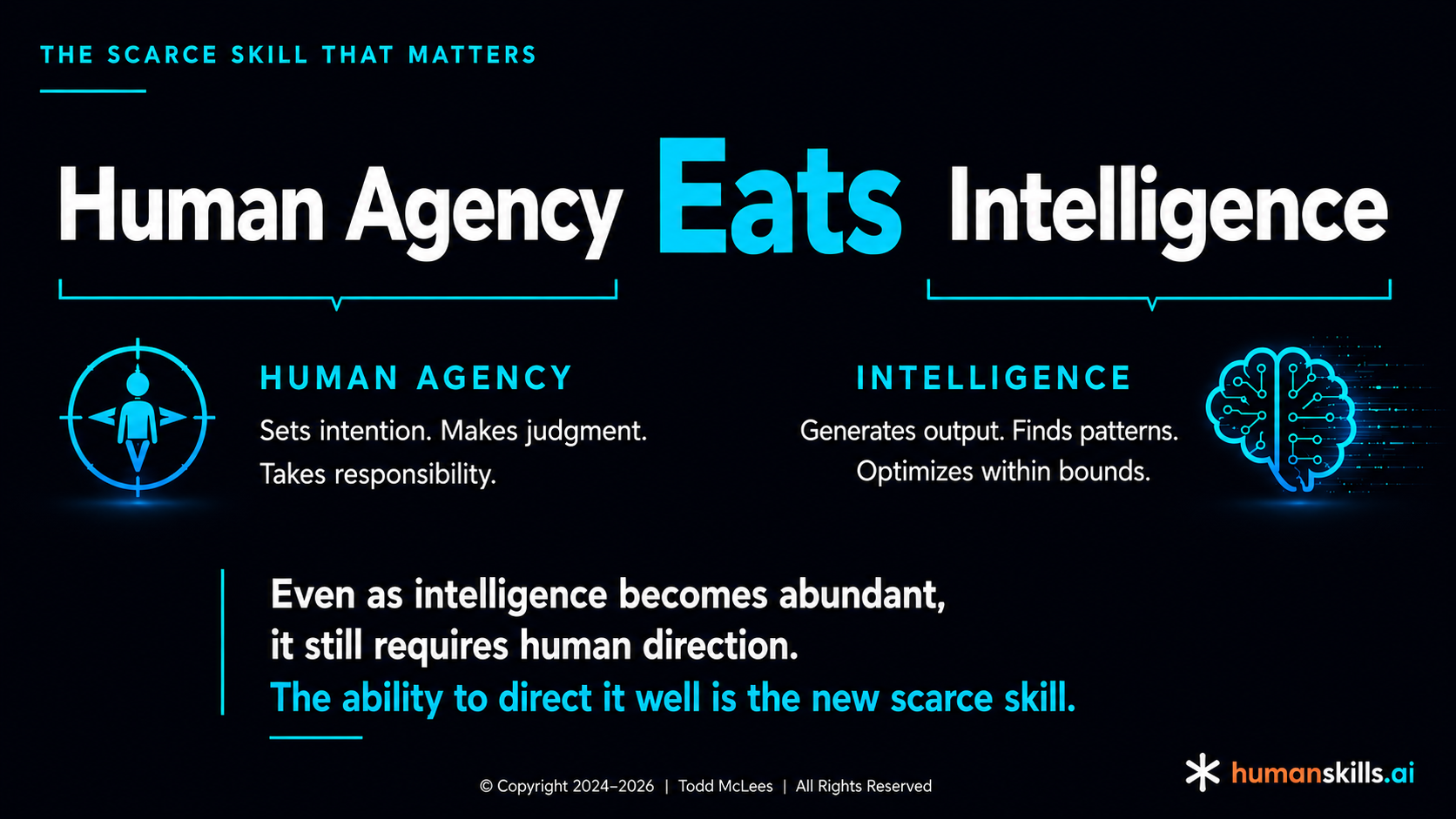
Human Agency Eats Intelligence: Where the Leverage Moves
The slide makes a structural claim worth slowing down on. When intelligence becomes abundant, the thing that becomes scarce is whatever the abundant resource depends on to produce value. For intelligence, that dependency is direction. Setting intention. Making judgment. Taking responsibility for the outcome. Those three capabilities are not new. They have always been the difference between thinking and decision-making. The shift is that they used to be packaged with intelligence inside the same human worker. Now they are separable from it, and the half that is separating off, the direction half, is where the leverage is moving.
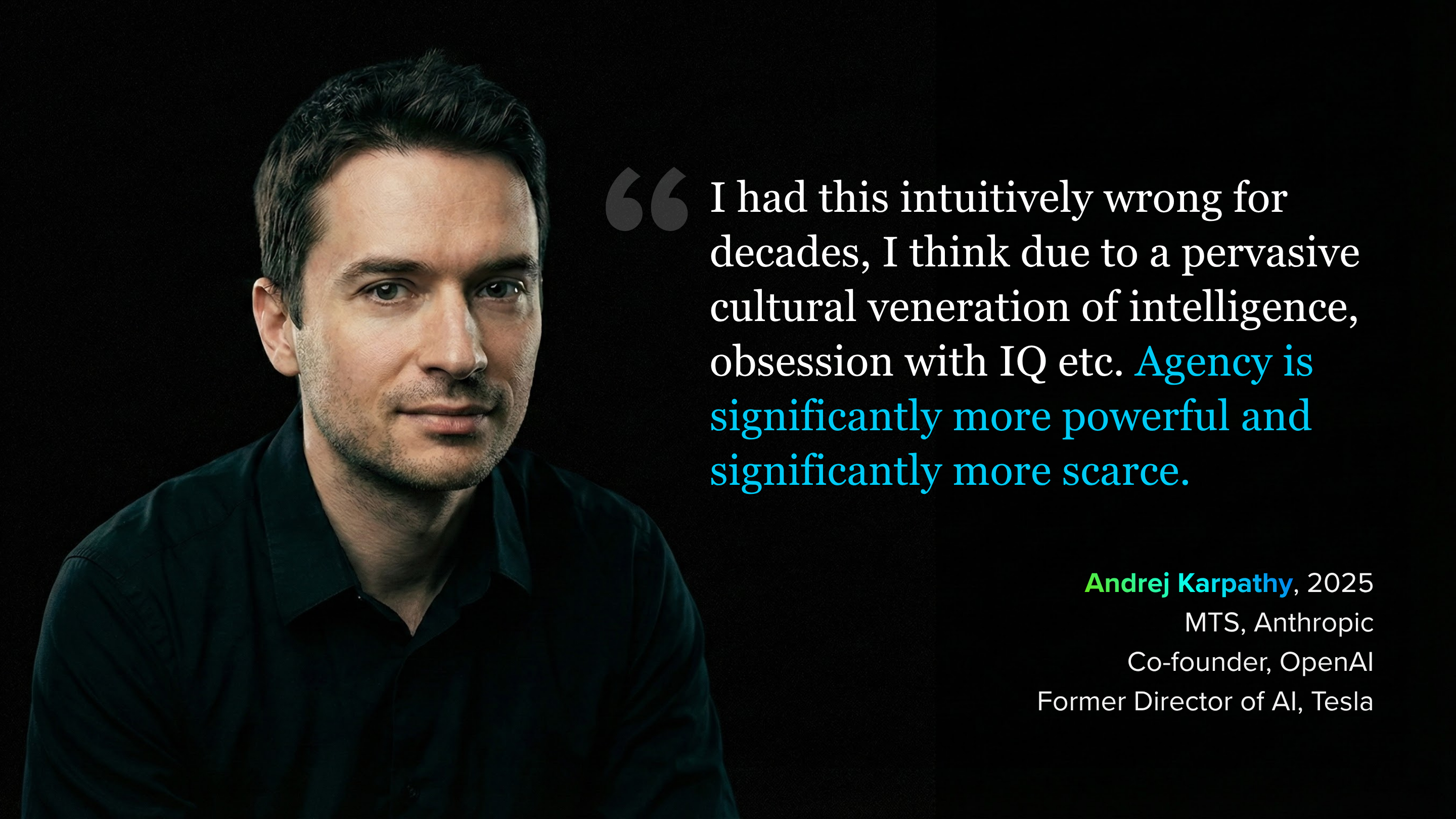
Reading Karpathy Closely
This is a confession, and it is worth reading as one. Andrej Karpathy is one of the people who built modern AI. He led computer vision at Tesla. He was a founding member of OpenAI. He spent two decades inside the assumption that intelligence is the rare, valuable resource. And here he is in 2025, saying that assumption is wrong. Not slightly wrong. Significantly wrong. Agency, the capacity to set direction, make judgment, take responsibility for consequences, is the more powerful resource and the scarcer one. That is not a marketing claim or a thought-leadership take. It is an engineer's revised model after watching the systems he helped build reach a point where intelligence is no longer the bottleneck. The bottleneck is what intelligence is pointed at, and who is accountable for the point.
The Fourth Great Economic Transformation
Every economic revolution makes something previously scarce abundant. Every time it happens, what becomes valuable shifts. Food surplus made agrarian skill the rare and valuable capacity. Mechanical power made manufacturing capability the rare and valuable capacity. Computation made knowledge work the rare and valuable capacity. We are inside the fourth. Intelligence is becoming abundant, and value is shifting again, this time to the human capacity to decide what intelligence gets pointed at, judge whether the output is any good, and own the consequences. The row at the bottom of each column is the operational consequence worth holding. Each revolution required a new way of organizing how work flows. The fourth requires agentic workflow design. The people and institutions that learn it quickly enough to lead inside the next eighteen months are the ones who will define what this economy looks like.
Three Forces of the Agency Economy
The popular framing pits humans against AI, or pairs them as two forces learning to work together. The slide makes a more precise structural claim. There are three forces, and the middle one is the one most people skip past. Human agency sets direction and owns consequences. Agentic AI scales execution and finds patterns. Agentic workflows are the architecture in between, the bridge that lets the first two combine into outcomes rather than collisions. Strip out the middle, and what is left is either a human typing prompts into a chat window or an AI doing impressive things no one can act on. Strip out human agency, and the system runs on autopilot toward whatever optimization function was set last. Strip out agentic AI, and what remains is a slower, less capable version of what existed before. The point is structural. All three are required because the system does not work otherwise.
Artificial Intelligence ≠ Human-Directed Intelligence
This is the slide where the deck's central argument becomes a structural claim instead of a thematic one. AI generates capability. That is what the technology does. It generates outputs, finds patterns, optimizes within bounds someone else set. None of that is value yet. Value forms when capability meets intention, judgment, and accountability for consequences. The two columns differ in one specific way that matters operationally. The left column scales. More compute, more output, predictably. The right column does not scale that way. It builds slowly, in people, through use, and it does not arrive automatically just because the left column gets more powerful. Which makes the right column the bottleneck. And bottlenecks are where strategy lives.
How Fast is AI Climbing? Reframing the Forecast
The slide reframes the forecasting question. The popular debate is whether AI capability follows an S-curve or stays exponential. The slide's argument is that both shapes eventually level off, and the actual strategic variable is when. A two-year exponential phase produces a very different world than a ten-year one. The institutions, workflows, and capability investments that make sense in each scenario are not the same. Which is why so much AI planning quietly falls apart inside eighteen months. It got built around a shape rather than a duration, and then the duration showed up.
Can Human Agency Keep Pace? The Second Curve
The previous slide reframed the capability question as duration, not shape. This slide reframes it again, and the reframe is the one the rest of the deck rests on. There is not one curve to track. There are two. AI capability rises on its own timeline, driven by compute, data, and architecture. Directing Intelligence rises on a different timeline, driven by how fast institutions and individuals build the capacity to set intent, exercise judgment, and own consequences for what AI does on their behalf. The gap between the two curves is not a chart artifact. It is the operating environment of the next eighteen months. Every strategic question worth asking right now, what to build, what to delegate, what to keep human, where to invest in capability development, is downstream of the size and shape of that gap.
The Human Agency Stack
This is what Human Agency is actually made of, and the slide arranges it the way it operates. The left column is the inner foundation. Self-determination, self-efficacy, autonomy, metacognition, resilience, adaptability. These are the capacities that make agency possible. They are not soft. They are infrastructure. The right column is what those capacities produce when they meet the world. Intention, judgment, questions, meaning, ethics, accountability. These are the moves that direct intelligence. Read the arrows. Internal is upstream of external. You cannot exercise judgment if you have not developed metacognition. You cannot stay accountable if you have not built resilience. Most current approaches to AI training skip past the left column entirely. They teach the right column as a checklist. The slide names the left column as what makes the right column actually stick.
The Agentic AI Stack
The slide names a concept worth holding. The operating envelope is the contract between human agency and machine action. Goal, role, tools, rules, review. The left column is what humans bring to the contract. Intent, context, capabilities, constraints, criteria, authority, feedback. The right column is what agents do inside it. Interpret, plan, act, observe, adapt, escalate, report. The dashed loop at the bottom is what turns the structure into a learning system rather than a one-shot transaction. Telemetry flows back. Direction improves. Execution improves. Which surfaces the operational definition of working with agentic AI well. It is not prompt engineering. It is envelope design. Setting the goal, granting the right authority, defining what the agent can change and what must escalate, then watching what comes back and tightening the envelope around what works. That is the work of Directing Intelligence at the agentic level.
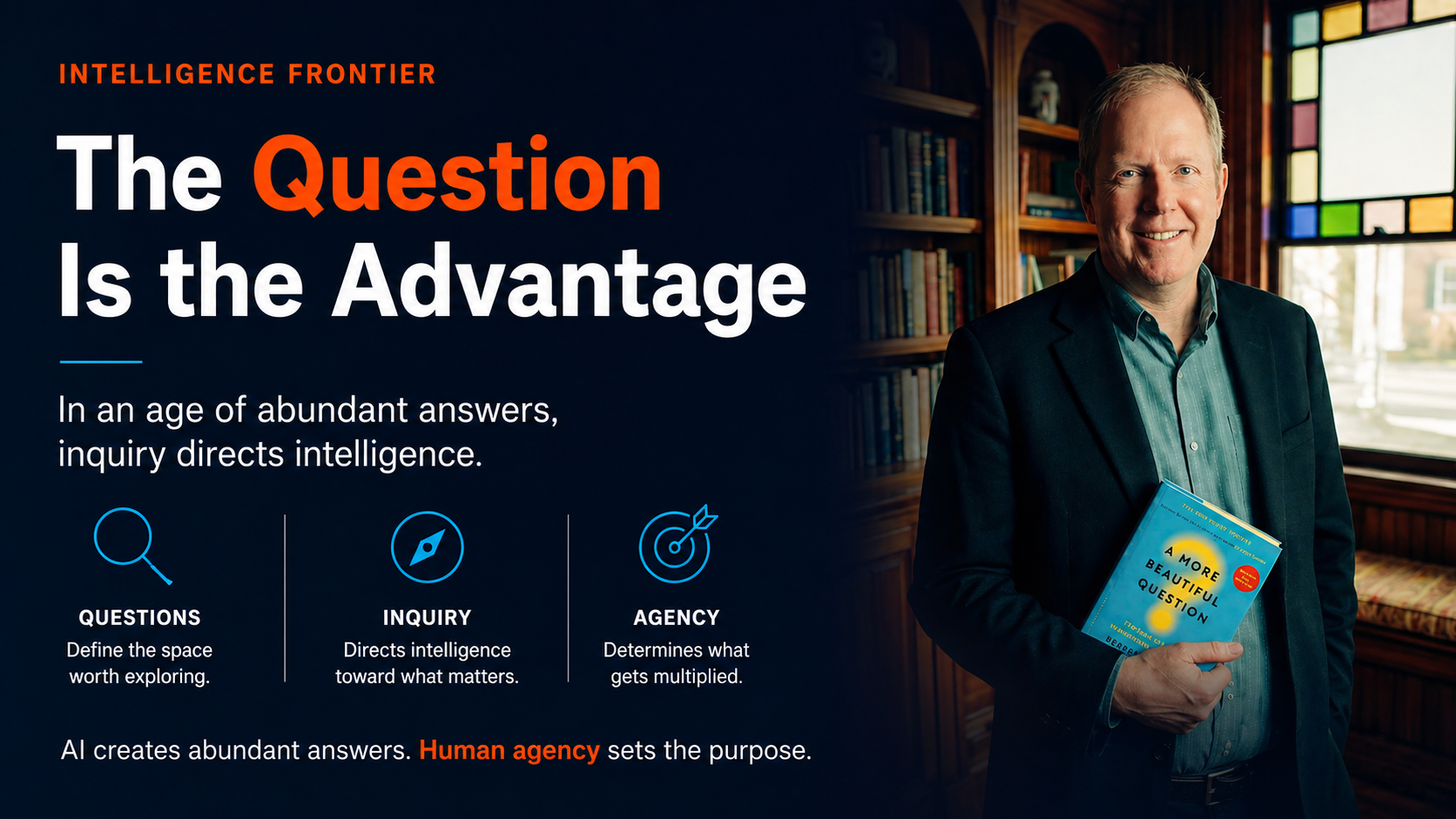
The Power of Inquiry to Spark Breakthrough Ideas
Warren Berger wrote A More Beautiful Question before the current AI wave started. His thesis was already useful then. It becomes structural now. When answers are scarce, the person with the best answer wins. When answers are abundant, the person with the best question does. Inquiry is not a soft skill. It is the operating capability that decides what gets investigated, what gets multiplied, and what gets ignored. The three columns at the bottom of the slide are the chain. Questions define the space worth exploring. Inquiry directs intelligence toward what matters. Agency determines what gets multiplied. AI does not produce any of those moves. It produces the answers that follow them. Which is why the strategic advantage is not access to intelligence. It is the quality of the questions being pointed at it.
What Becomes Possible When Intelligence Is Abundant?
What humans choose to multiply. Three frontier moves earn the strategic attention. Scaling what already works, because abundant intelligence makes proven approaches reachable for ten times the people who could not afford them before. Attacking what felt impossible, because problems that used to require an army of specialists are now solvable by a small team with the right direction. Leading the human core, because the deeper AI capability becomes, the more visible the work that has to stay human. Purpose, judgment, accountability, meaning. The shape of the next eighteen months will be decided by which institutions take all three moves seriously, and which assume the third one will take care of itself.
We Are Lacking for Abundant Intelligence Use-Cases
Most current AI deployment is concentrated in the bottom-left quadrant. Automating existing work. Cutting time and cost. Doing today's work faster. These are real wins, and they are also the use cases built for an era when intelligence was scarce. The top-right quadrant is what the technology actually makes possible. Breakthrough products. New business models. Novel workflows. Step-change productivity. Previously impossible solutions. The empty space between the two quadrants is the slide's quiet diagnosis. The bottleneck is not capability. It is the human capacity to imagine, choose, and build what becomes possible when intelligence is no longer the constraint. The slide names this the Agency Gap. Closing it is the work.
Generative AI Value-Creation Pyramid
I developed this framework was developed with Greg Satell and Nicole Radziwill, and it was published in HBR. Microsoft still uses for their enterprise work. It maps the sequence of where AI value comes from inside an organization without skipping the work. Level 1 is individual productivity. The fast wins. Level 2 is team-level integration, where AI becomes a real participant in how groups think and decide. Level 3 is the redesign of core processes for a world where intelligence is abundant. Level 4 is what the previous three levels make possible. New markets. New products. Business models that did not exist before. Most organizations stall at Level 1 and call it transformation. The pyramid names what the levels above require. Slow work. Sustained investment. And human agency strong enough to imagine what Level 4 actually looks like before it has been built.
Now We Are All Directing Intelligence: As AI Capability Increases, Human Responsibility Shifts to Direction
This is the competency model the rest of the work hangs on. From AI Literacy at L0 to Chief Intelligence Officer at L7. The progression is more capablity scope than career ladder. The same underlying skill of Directing Intelligence applied at progressively larger scale, with progressively larger consequences. L4, the Director of Intelligence, is the inflection point, because the shift from directing your own workflow to directing agents acting on your behalf is the move every knowledge professional now has to make. The three foundations at the bottom run through every level. Responsible AI is the standard to build to. Human Agency is the capability to design for. Sustainable Use is the practice that protects what matters across time. Most current AI training stops at L0 or L1. The work of the next decade is at L4 and above.
Andrew Ng on the Improtance of Workflows
The temptation in this discourse is to read AI progress as a model-size story. Bigger models, more capability, more impact. Ng is telling us that view is incomplete. Bigger models are not where the next round of value gets unlocked. Workflows are. The capability is now table stakes. The advantage is in how the capability gets sequenced, who owns which decisions in the chain, where AI executes and where humans intervene, and how the whole thing gets monitored and improved. That is workflow design, and it is the discipline most organizations have not yet built. Ng has trained more of the world's AI talent than almost anyone alive. When he says the next phase is workflows, that is not a hot take. It is what he is watching happen in practice.
David Solomon: "The Last 5% Now Matters Because the Rest Is Now a Commodity"
David Solomon runs Goldman Sachs. The firm makes its money on judgment work at the highest end of the market. When he says the last 5% now matters because the rest is a commodity, he is naming the structural shift inside his own business. The drafting, the analysis, the modeling, the comparable transactions, the boilerplate language, the formatting, all of it is moving toward parity through AI. The last 5% is what is left. The judgment about which deal to do. The relationship that lets the deal close. The read of the room in the IPO roadshow. The accountability when the filing lands wrong. That is not a small remainder. It is the entire premium the firm earns over a commoditized competitor. The H5 marker on the slide is Brynjolfsson's scale telling you the same thing in academic language. The last 5% is Full Human Agency. The rest is now executable by anyone with the right tools.
What Goes Wrong If This Fails?
Most AI strategy decks lead with upside. This slide does the harder work. AI accelerates the S-1 workflow, which is the value proposition. AI also accelerates whatever goes wrong inside it, which is the risk proposition almost no one writes down. The five categories are not theoretical. They are the actual failure modes of an AI-augmented elite professional services workflow. Reputational damage. Regulatory action. Loss of client trust. Brand equity destruction. Data exposure. Each one is irreversible at the speed AI can produce it. The row under each risk is what human judgment does in the workflow. Senior banker sign-off. Compliance guardrails. Client-ready quality validation. Escalation when quality is at risk. Encryption and access controls. Read the bottom of the slide as the strategic claim it is. AI increases the risk surface. Human judgment protects the firm. That is the operating frame for deploying AI inside any business where mistakes compound.
Human Agency Scale: Opportunities for Human-AI Collaboration
A five-level scale from H1 to H5. H1 is autonomous AI with humans on alert. H2 is delegated AI with humans approving at milestones. H3 is shared agency in an iterative loop. H4 is augmented human agency, with AI expanding what the person can do. H5 is full human control. AI Drives on the left, Partnership in the middle, Human Drives on the right. Not a ranking, a set of choices.
Shao, Y., Zope, H., Jiang, Y., Pei, J., Nguyen, D., Brynjolfsson, E., and Yang, D. (2025). Future of Work with AI Agents: Auditing Automation and Augmentation Potential across the U.S. Workforce. arXiv:2506.06576. https://arxiv.org/abs/2506.06576
10 Stages to the Goldman Sachs S-1 Workflow
Read the pattern down the middle column. Mandate and framing at the top is H5, Full Human Agency. Post-mortem and learning at the bottom is H5. Everything in between distributes across H1 through H4. The judgment work anchors the ends. The execution work dominates the middle. This is a picture of how an elite professional services workflow restructures itself when AI is properly integrated. Risk and compliance lands at H1 because the patterns are clear and the variance is bounded. Financial modeling lands at H2 because humans set the assumptions and AI runs the calculations. Narrative drafting and internal review land at H3, where the work requires both pattern recognition at scale and judgment about audience and tone. Investor roadshow and pricing sit at H4 because the stakes are too high to delegate, but AI is doing real analytical work in the background. The ends, the framing of why this deal exists and the learning that comes after it closes, remain H5. That is where the firm's actual judgment lives. The slide is the operational picture of David Solomon's last 5%.
Goldman Sachs S-1 Workflow: Human Agency Task Time Distribution
This is the same workflow as the prior slide, rendered as a curve. The line drops from H5 at Mandate and Framing down to H1 at Data Assembly, climbs back through Financial Modeling and Narrative Drafting, falls again at Risk and Compliance, holds in shared territory through Internal Review and Regulator Interaction, then rises through the Investor Roadshow and Pricing toward Post-Mortem and Learning at H5. The W-shape is what an AI-augmented elite workflow actually looks like when the matching is done right. Judgment anchors the ends. Automation dominates the middle. Shared work fills the connective tissue. Most current AI deployment fails because it tries to flatten this curve, pushing everything toward H1 to maximize efficiency or holding everything at H5 to maximize control. The shape is the strategy. The strategy is matching every stage to the level where the work actually belongs.
S-1 Workflow Economics Are Changing
Six bankers, six weeks, thirty-six human-weeks of effort at $300,000-$540,000 per filing. That was the cost structure of the traditional workflow. The agentic version handles seventy-five percent of the work through AI, sixty percent fully automated and fifteen percent AI-executed with human oversight. The remaining 25% is the work humans now own. 10% collaborative. 10% human-led with augmentation. 5% human-led with full control. Time compresses from six weeks to one or two. Cost compresses by roughly two-thirds. The strategic number is the talent leverage at the bottom. Senior bankers stop spending their week on production work and start spending it on judgment, relationships, and high-stakes decisions. The execution layer collapses. The judgment layer becomes the differentiator. Which is the point made a few slides back, now denominated in ROI.
The Impact of Agentic AI on the S-1 Workflow
The headline number is thirty-six weeks to nine or twelve. Sixty-five to seventy-five percent less human effort. The cleaner read of the slide is in the figure icons. Six full bankers become two solid figures and four dotted outlines. The dotted figures are not laid off. They are redeployed. To more deals. To deeper analysis. To client work that was previously deferred because the production load was too heavy. Which surfaces the strategic insight underneath the headline. The savings from AI-augmented workflows do not show up as cost reduction in the standard sense. They show up as capacity expansion. The same talent doing more, with sharper focus on what only they can do. The closing line on the slide is the operating frame. Value shifts to the decisions, not the production. Which means the institutions that win the next decade are the ones that build the decision-making capacity faster than they capture the production-cost savings.
AI Roles Mapped to Human Agency: Faculty Determine the Role, H-Level Sets the Boundary
Nadella runs the company that has spent more on AI infrastructure than any organization in history. More than $100 billion in fiscal 2026 alone. Read the quote with that context. He is not telling you that agentic systems are interesting, or promising, or coming. He is telling you that every firm will need to reconceptualize work to use them. That is a different verb. Reconceptualize means the existing categories do not work anymore. The job descriptions, the team structures, the workflow maps, the performance metrics, the org charts. All of them were designed for a world where humans did the execution and the judgment together in the same role. Agentic AI separates the two. Which is why the opportunity is not to do current work faster. It is to expand human agency and redesign how work gets done. The redesign is the work. Nothing else in this decade matters more.
Now We Are All Directing Intelligence (L0–L4)
The previous section introduced the eight-level competency model. This slide takes the first five levels and makes a specific claim. L0 through L4 is not a leadership track. It is the foundational capability set every knowledge worker now has to develop. AI Literacy at L0 is the entry point. AI Agility at L1 is where most current training stops. L2 and L3 are where workflow redesign happens. L4 is the inflection point, where individual workers move from directing their own AI interactions to directing agents acting on their behalf. The slide labels it "All of Us" because that is the move every professional in every knowledge industry has to make inside the next eighteen months. The three foundations at the bottom carry through every level. Responsible AI sets the standard. Human Agency is what gets developed. Sustainable Use is what protects the capability over time. Most organizations are training to L1 and calling it AI literacy. The work of the decade lives at L4.
Directing Intelligence at Scale (L5–L7)
The previous slide named L4 as the inflection point for individuals. This slide names what comes next at the institutional level. L5, Hybrid Intelligence Orchestration, is the capability to direct teams that include humans and agents working together. L6, Intelligence Ecosystem Design, is the capability to design the systems and infrastructure that let hybrid teams operate at scale across functions. L7, Agentic Strategy and Vision, is the capability to set the direction for an entire enterprise operating with intelligence as an abundant input. These are not promotions. They are scope expansions of the same underlying capability of Directing Intelligence. Most C-suites do not yet have anyone operating at L6 or L7. The CIO acronym traditionally meant Chief Information Officer. The role this slide names, Chief Intelligence Officer, is a different job. It is the institutional accountability for how the firm directs intelligence across every workflow, every team, every decision. Which is the role most organizations will spend the next five years figuring out how to fill.
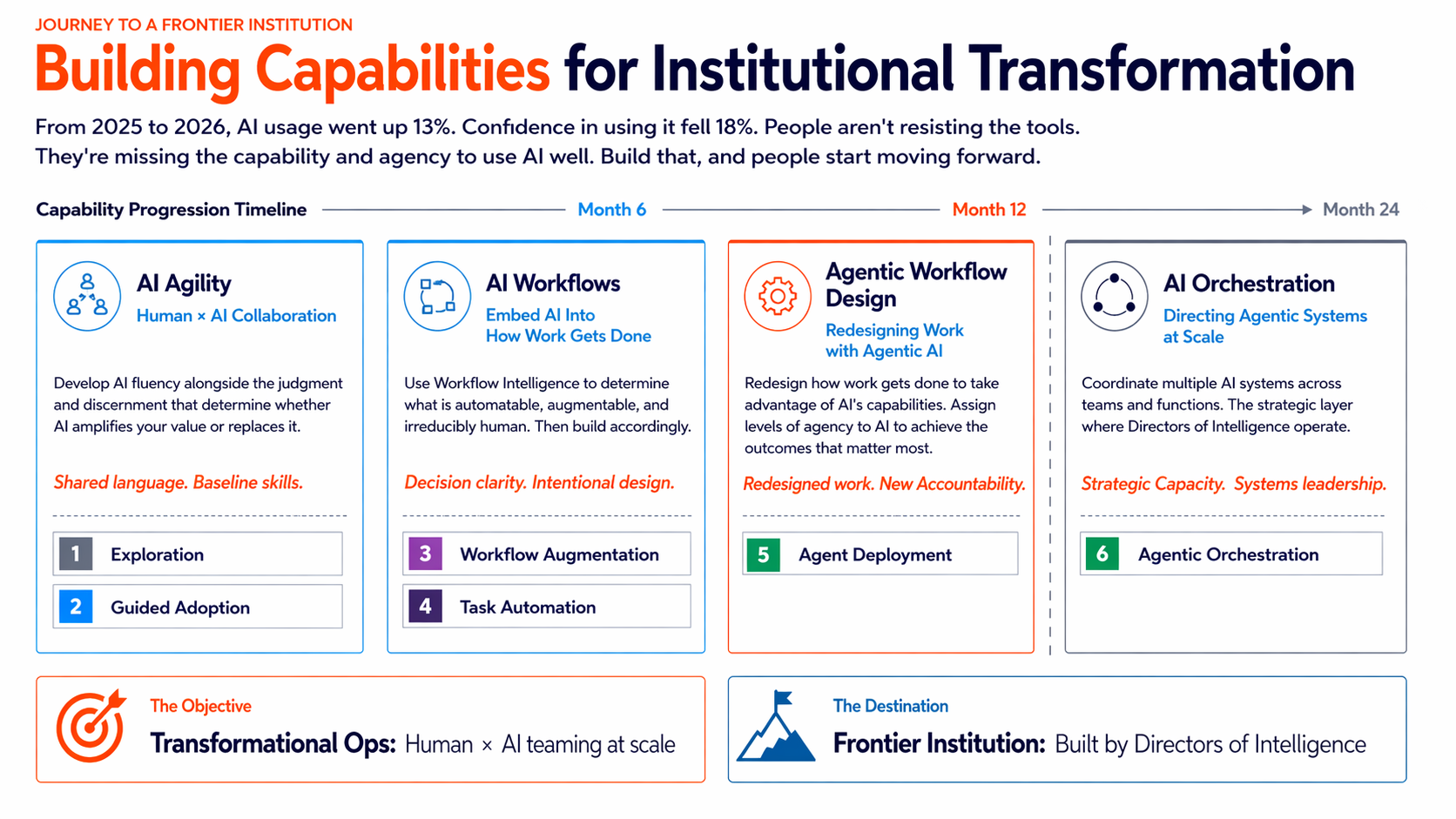
Building Capabilities for Institutional Transformation: The Journey to a Frontier Institution
The two numbers at the top of the slide are the diagnosis. AI usage went up thirteen percent from 2025 to 2026. Confidence in using AI fell eighteen percent across the same period. Those numbers move in opposite directions for a reason. People are using the tools more and trusting their own judgment with them less. The gap is the capability gap. The roadmap below is what closes it. AI Agility builds the foundation, the shared language and baseline skills that make adoption coherent. AI Workflows develops the decision clarity to know what to automate, augment, and keep human. Agentic Workflow Design is where the redesign happens, the redrawing of how work flows when agents are part of the team. AI Orchestration is the strategic capacity to coordinate intelligence across the whole institution. Twenty-four months. Four capability layers. One destination, named at the bottom of the slide. A frontier institution is one whose people have built the capacity to direct intelligence at every level. Most organizations are still trying to deploy tools. This roadmap is what it looks like to build the capacity.