More capacity for care
Reduce avoidable administration and rework so time can support patients, coordination and staff well-being.

Human capability for health systems
Your teams are caring for patients, managing growing demands and keeping your health system moving. AI should help make that work better.
Build the judgment, practical skills and ability to improve workflows that turn AI investment into useful change.
Why this matters
A new rollout can ask the same nurse to learn a tool, check its output and explain it to a patient, while keeping the shift moving. Concerns about accuracy, workload and patient relationships deserve a serious response.[2]
Reduce avoidable administration and rework so time can support patients, coordination and staff well-being.
Help clinicians and operational staff recognize where AI can help in their roles and use it consistently in everyday work.
Protect patient and organizational information, recognize bias and unreliable outputs, and keep human accountability clear.
Connect AI use to access, responsiveness, workload and operating performance, with evidence behind investment decisions.
Adoption and implementation challenges
Choose the challenge closest to your experience. Explore what your team needs to become capable of doing, the organizational benefit and a practical way to recognize progress.
A nurse still has a full patient assignment. A clinician still has notes to finish. Learning a tool, correcting its output and changing routines all take time alongside the work your teams already carry.[2]
Frame a useful task, give AI clear direction and check whether the result meets the team's standard.
Time spent creating and checking work, after-hours documentation, rework and staff experience. Decide how any recovered capacity will be used.
Which recurring task would your clinicians or staff most value improving?
An omitted detail can matter more than a polished summary. Clinicians need evidence that a tool is suitable for their patients, a voice in its introduction and authority to question the result.[10]
Evaluate outputs, articulate concerns and make human responsibility explicit.
Correction patterns, demonstrated escalation and evidence that frontline feedback changed implementation. Clinical teams monitor safety and performance across patient groups.
Who can challenge an AI-supported decision, and what happens when they do?
Staff under pressure may reach for the easiest available tool. If permitted uses, information boundaries or alternatives are unclear, a policy can leave people guessing in the moment.[9]
Apply policy to a real decision about tools, data, review and escalation.
How staff handle realistic privacy and tool-use scenarios, support-request turnaround and whether concerns are surfaced and resolved.
Where does the approved route make the work harder to complete?
A faster note or referral summary can still leave duplicate entry, missing information and another handoff. Integration, data quality and unclear roles can stop a useful pilot from becoming dependable practice.[1]
Design tasks, decision points, permissions and human review across an entire workflow.
End-to-end turnaround, duplicate entry, avoidable handoffs, rework and unresolved exceptions.
Where does the work get stuck after the AI finishes its part?
One department has confident users. Another is still deciding what is appropriate. A successful demonstration does not give every clinician, manager or support team a dependable way to work.[2]
Make effective context, instructions and quality checks visible, teachable and repeatable.
Whether different team members can produce acceptable work using a shared method, explain their checks and improve it through feedback.
What does your strongest user know that the next team needs?
More logins and faster individual tasks do not tell your board whether access improved, staff burden fell or costs changed. A gain in one role can move work somewhere else.[3]
Connect workflow design to a baseline, a clear owner and a measure that matters to patients, staff or operations.
Referral turnaround, waiting time, cost per completed process, rework or capacity actually redeployed. Finance validates financial attribution.
What should become measurably better for patients, staff or the organization?

Responsible & Ethical AI
You need people to benefit from AI without guessing about patient privacy, reliability or who owns the next decision.
Shadow AI is part of this challenge. In a vendor-sponsored survey of 518 U.S. providers and administrators, 17% reported using unapproved tools. Faster workflows were a leading reason.[9]
Give staff a usable way to request an alternative. Practice the decision about which tool and information are permitted, and when to stop and ask for support.
Check the source, the missing context and the people affected. The person reviewing the work needs time, judgment and authority to correct it.
Make scope, permissions and human approval explicit. Clinical decisions and exceptions need a clear owner and an intervention route.
Agency. Capability. Imagination.
Technology changes what is possible. People need a clear role, practical skills and room to rethink work to turn that possibility into better care and better performance.

Clinicians and staff need to see where AI fits in their role, what they control and what they remain accountable for. Within clinical and organizational safeguards, they can direct its use toward accuracy, compliance and their health system's goals.
Build ownership of AI use and its outcomes.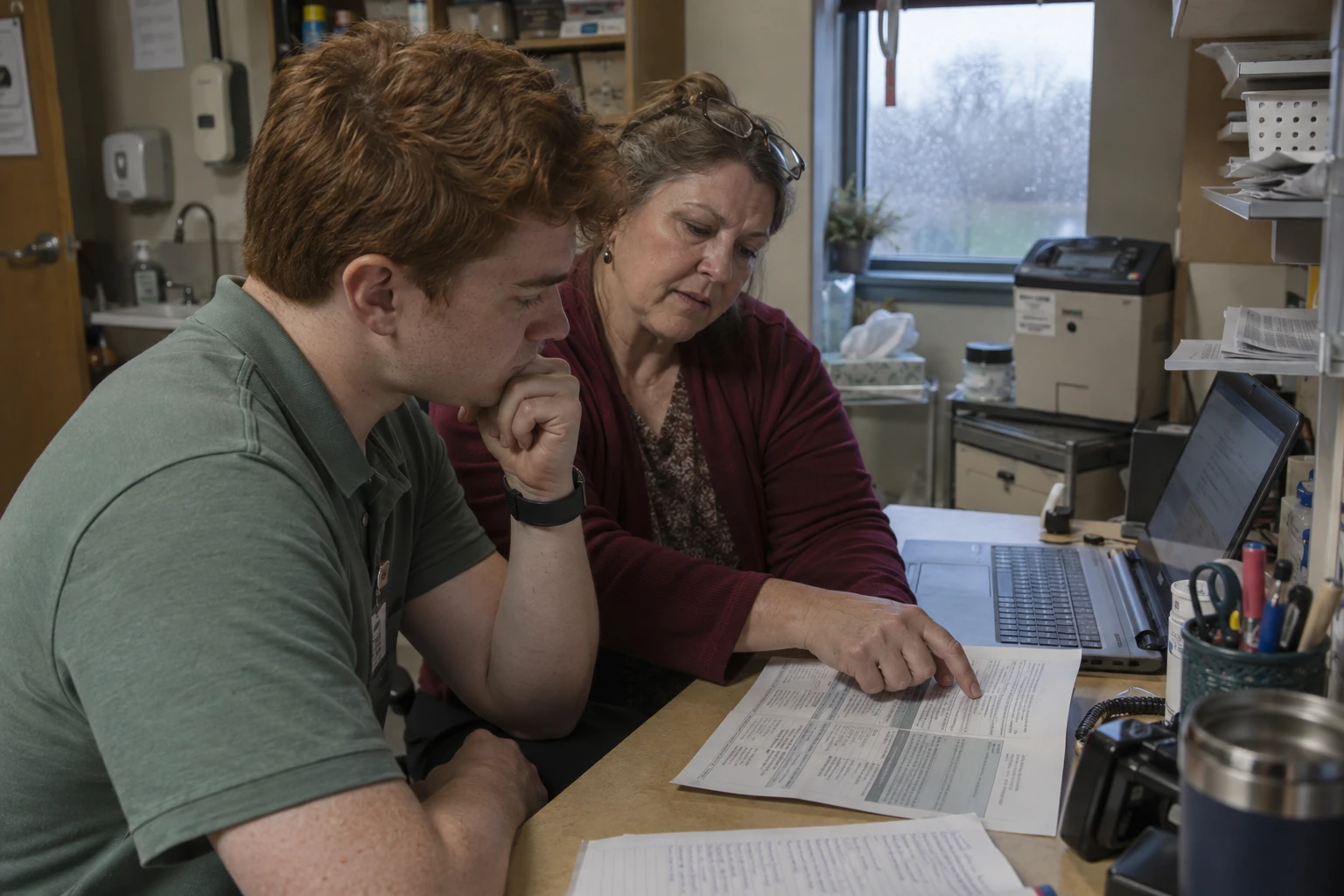
Access reaches the team. Reliable practice requires context, verification, privacy awareness and shared standards.
Build skills people can demonstrate at work.
A task gets faster. The larger opportunity is a better flow across care teams, services and patients.
Build the ability to design better ways of working.Capability building helps people shape and direct the change. Clinical validation, EHR integration, suitable tools, staffing and real decision-making authority remain essential.
Make the organizational benefit visible
Consider a referral that moves between administrative staff, clinical reviewers and scheduling. AI can assist with parts of the work. The patient benefits when the whole process becomes more dependable.
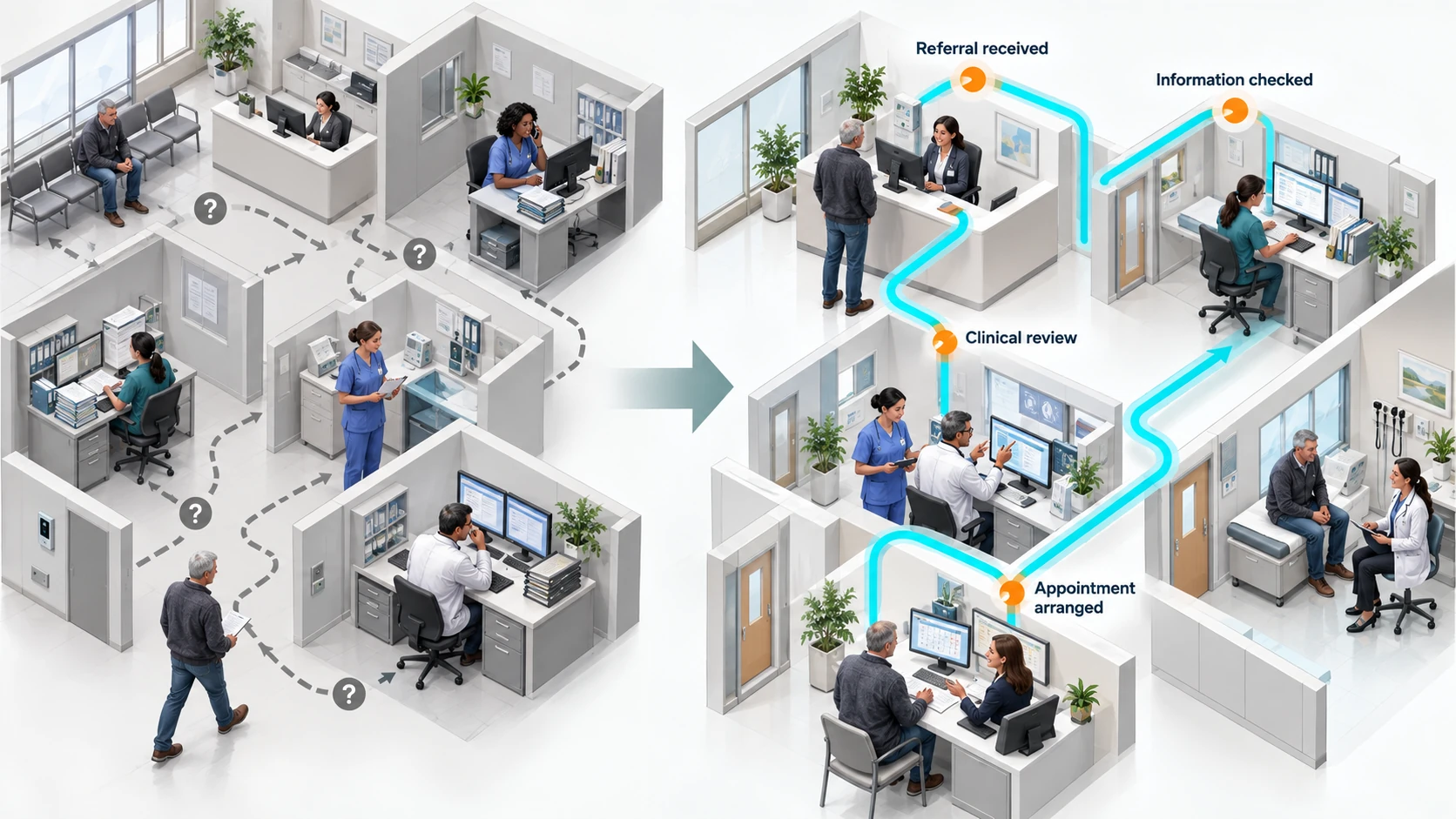
Swipe across the graphic to follow the referral journey.
Staff verify completeness and route missing details for follow-up.
Qualified clinicians own decisions that require clinical review.
Each person knows the next action, owner and exception route.
Track turnaround, avoidable rework and patient follow-up.
This is the kind of thinking AI Workflows + Agents develops: mapping the work, assigning responsibility and designing a process people can direct.
Explore a workflow-focused cohortPublished health-system experience
Real results depend on the tool, the task and the people around it. These cases offer useful lessons for the next decision in your health system.
UW Health / Ambient documentation
A randomized trial found about 22 fewer minutes on notes per normalized eight-hour workday, alongside lower exhaustion and interpersonal disengagement.
Measure the burden and the clinician's experience.66 practitioners over 24 weeks. Professional fulfillment did not significantly improve. One system with willing adopters limits generalization; the study does not establish patient benefit or financial return.
View the UW Health studyUCLA Health / Comparing AI scribes
In a randomized trial of 238 physicians, one documentation tool reduced writing time significantly; the other did not. Clinicians reported occasional inaccuracies.
Evaluate the product in your local workflow.Nabla reduced writing time-in-note by 9.5% versus control. DAX Copilot's 1.7% reduction was not statistically significant. Short follow-up and English-only encounters limit generalization. This is not a current vendor ranking.
View the UCLA Health studyStanford Health Care / Deterioration
Predictive alerts and nurse-physician huddles were associated with fewer escalation events among patients near the alert threshold.
Design what people do after the AI signal.An observational evaluation across four medical units found a 10.4-percentage-point reduction in a composite of rapid-response activation, ICU transfer and cardiopulmonary arrest near the threshold. Mortality did not significantly improve.
View the Stanford studyThese are external health-system studies, not humanskills.ai program outcomes.
Develop the people behind the implementation
We call this Directing Intelligence: deciding where AI can help, giving it purpose and context, evaluating its work and owning the result.
Start with the responsibilities your clinical, operational and support teams carry. Match the learning to the work they need to improve.

Human-First AI Literacy and Human × AI Fluency
Choose appropriate uses, give clear direction and evaluate AI-generated work. Staff can explain what they checked and what remains their responsibility.
A consistent starting point across clinical, operational and support teams.
Explore AI FoundationsTurn principles into everyday judgment
Practice decisions about sensitive information, evidence, bias and accountability. Recognize when an answer should be accepted, challenged or escalated.
More consistent responsible use, with clearer privacy boundaries and protection for patient trust.
Plan responsible AI learningMake useful practice repeatable
Develop reusable context, instructions and quality criteria for recurring work such as hospital operations briefings and care-team communications. Test and improve the approach.
Less avoidable rework and useful methods that can spread beyond individual enthusiasts.
Explore an AI Agility cohortDesign the work with clear human ownership
Map tasks, decisions and handoffs. Specify permissions, approval points and exception routes before delegating work to AI.
Better coordination across services, clearer ownership and a way to evaluate end-to-end performance.
Plan a workflow-focused cohortWith Virgil, our Agentic Learning Guide, participants practice an approach, create work they can examine, explain their decisions and improve the result. Use synthetic or approved nonsensitive material. The programs build transferable AI capability alongside your clinical, tool-specific and organization-specific training.
Delivered through our higher education partners
humanskills.ai brings the programs and guided practice. Our higher education partners connect your organization with learning opportunities, private cohorts and enrollment arrangements.
Asynchronous learning can fit alongside the working day. Agree on protected time and support so participation is realistic.
Let's make it concrete
Start with one team and a priority that matters to patients, staff or operations.
The healthcare evidence behind the page
Reviewed September 2026. These organizations are research sources; inclusion does not imply partnership or endorsement. Surveys, consultancy cases and clinical studies provide different kinds of evidence.
April 2026. Directional survey of 150 U.S. healthcare leaders, including 50 care organizations; integration and internal capability were major scaling barriers.
May 2026. Survey of 521 frontline U.S. nurses. Accuracy, human interaction and privacy concerns require attention beyond training alone.
August 2026. Survey of 64 U.S. healthcare CFOs, evenly split between providers and payers. Self-reported measurement practices, not audited returns.
March 2025 report based on 300 U.S. provider executives surveyed in June 2024. Historical readiness snapshot; modeled potential is not realized savings.
January 2026. BCG reports 20% shorter call handling in an unnamed European health system. Consultancy-reported case without independent evaluation.
NEJM AI, November 2025. Randomized trial of 66 practitioners. Note-time reduction normalized to an eight-hour workday; one system and willing adopters.
NEJM AI, November 2025. Randomized trial of 238 physicians; product-specific results, short follow-up and English-only encounters.
JAMA Internal Medicine, March 2024. Observational evaluation near an alert threshold. Combined model, alerts and huddles; no significant mortality improvement.
January 2026. Vendor-sponsored survey of 518 U.S. providers and administrators. 17% reported unapproved use; 45% of those users cited faster workflow.
September 2025. Joint Commission and CHAI guidance on governance, privacy, monitoring, bias and education. Guidance does not validate a product or program.